
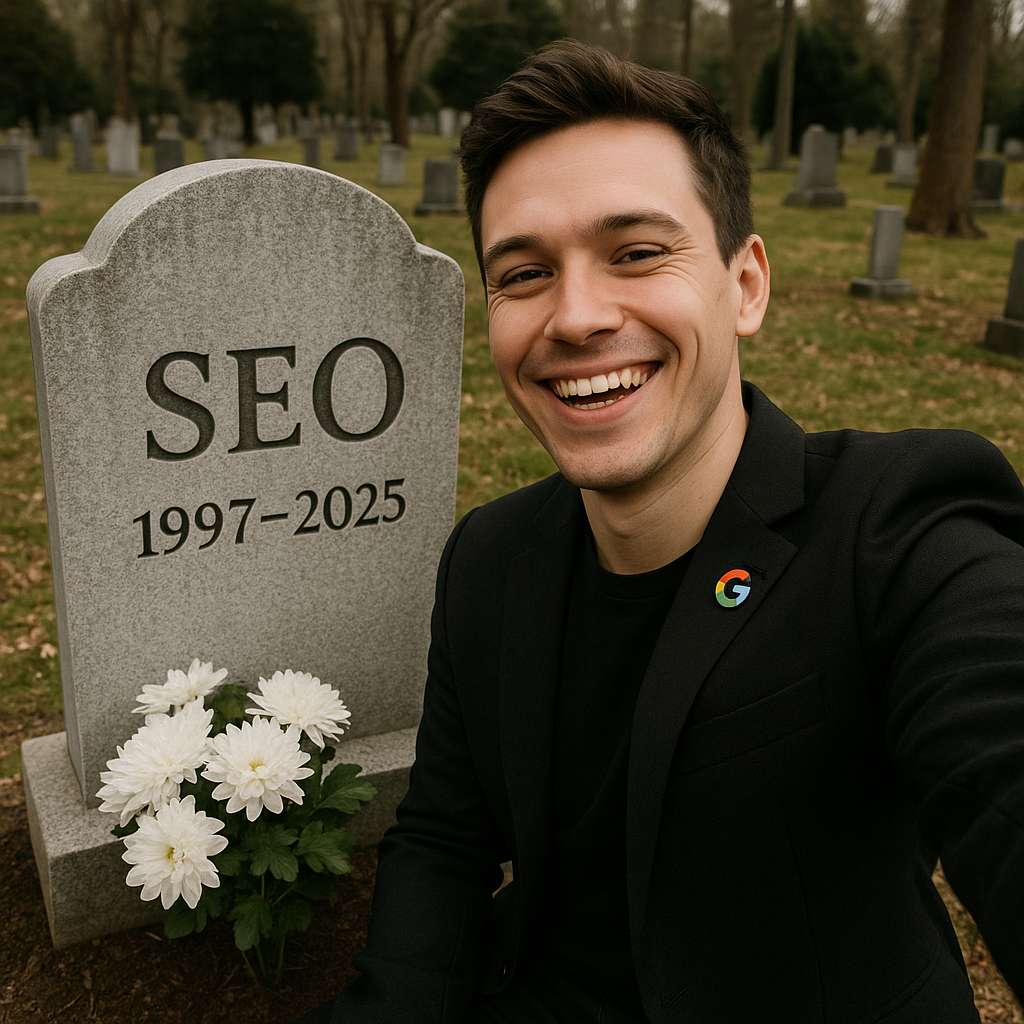
We’re witnessing a quiet exodus in the SEO industry.
Agency owners who spent years building seven-figure businesses are suddenly selling and moving on. The reason? Artificial intelligence is fundamentally reshaping search economics, and many see the writing on the wall.
The traditional SEO agency model faces an existential threat unlike anything we’ve seen before. This isn’t a simple algorithm update or a new Google feature. It’s a complete transformation of how search works and what users expect.
Let’s unpack what’s happening and why it matters for everyone in digital marketing.
The Economics of SEO Are Being Rewritten
AI is dramatically reshaping SEO economics by slashing costs, automating expertise, and forcing agencies to evolve fast or face extinction. The math simply doesn’t work anymore for many traditional models.
Think about what clients have historically paid for: technical expertise, content creation, link building strategies, and ongoing optimization. Now AI tools can handle much of this work at a fraction of the cost.
Where agencies once charged $2,000 to $20,000 monthly for comprehensive SEO services, AI-powered platforms can deliver comparable or superior results for $500 to $2,000. That’s not a small efficiency gain. It’s a complete restructuring of the value proposition.
The implications are profound for agency owners who have built their businesses on high-margin service models.
Real-World Impact: Why Seven-Figure Owners Are Selling
Consider the case of Mike Belasco. After building his SEO agency Inflow to over $4 million in annual revenue with 35 employees, he sold his business in 2024 after running it for 17 years.
His reason? “Honestly, after 17 years of running the agency, I was feeling a bit burnt out. I didn’t have the drive I used to.”
While burnout is certainly real, the timing suggests more factors at play. Many agency owners are recognizing that the next phase of SEO will require completely different operational models, technology investments, and expertise.
Some are choosing to exit at their peak rather than navigate the uncertain transition ahead.
Google’s AI Overviews: The Final Straw
For many SEO professionals, Google’s AI Overview feature represents a turning point. Data shows these AI-generated summaries have reduced click-through rates for position 1 results by 34.5% when present.
That’s an enormous hit to organic traffic.
Joy Hawkins, Owner of SterlingSky, confirms the trend: “We’re starting to see sites lose traffic due to AI Overviews. With the rise of AI on Google, it’s going to be challenging for SEOs to come up with more ways to get traffic to their clients’ sites.”
When your entire business model depends on driving organic traffic to client websites, a feature that keeps users on Google instead of clicking through represents an existential threat.
For information-based websites, some risk assessments indicate traffic declines ranging from 25% to 50% as AI features expand.
The Paradoxical Future of SEO Services
What’s emerging is a paradoxical future for the SEO industry.
As AI makes basic SEO more accessible, more businesses will likely invest in search optimization due to lower entry barriers. Yet we’ll probably see fewer but larger agencies emerging to serve this expanding market.
The middle will get squeezed out.
Small boutique agencies with specialized expertise or hyper-efficient operations may thrive. Massive agencies with strong brands and economies of scale will consolidate. But the typical mid-sized SEO agency faces the greatest risk of displacement.
This explains why many agency owners are choosing to sell now while valuations remain strong.
Strategic Adaptation – Three Paths Forward
For those committed to staying in the SEO space, three strategic paths are emerging:
1. The AI Implementation Specialist
Some agencies are pivoting to become experts in implementing and optimizing AI platforms for clients. Rather than doing the SEO work directly, they’re becoming consultants who help businesses leverage AI tools effectively.
This approach acknowledges the technological shift while maintaining a high-value advisory role.
2. The Brand-Focused Agency
Others are doubling down on brand building rather than technical SEO. As AI commoditizes technical optimization, the strongest agency brands with the best client relationships will maintain premium positioning.
These agencies focus on thought leadership, client education, and results-based case studies to differentiate themselves.
3. The Operational Efficiency Play
The third path involves dramatically reducing operational costs by embracing AI internally. These agencies leverage technology to serve more clients with fewer staff members, maintaining margins despite downward price pressure.
They’re essentially racing to the bottom on price while maintaining quality through automation.
Beyond Google – The Omnipresence Approach
Perhaps the most promising strategy involves expanding beyond Google-centric SEO altogether. As search behavior fragments across platforms, successful digital marketers are adopting an omnipresence approach.
This means establishing visibility across multiple platforms and formats:
• Social media content optimization
• Video search visibility on YouTube and TikTok
• Email marketing and owned audience development
• Discussion forum presence on Reddit and Quora
• Strategic paid media to complement organic efforts
The goal is creating unavoidable brand visibility across the digital ecosystem rather than relying exclusively on Google organic search.
What This Means For Your Business
Whether you run an agency, work within one, or manage SEO for your own business, the implications are clear: adapt now or risk obsolescence.
The most vulnerable sectors are content-focused affiliate sites and information-based websites monetized through ads. E-commerce, local businesses, and service providers remain relatively safer but will still need to evolve their strategies.
We’re entering a period of unprecedented turbulence in digital marketing that will require continuous adaptation. The environment will reward those who can maintain visibility across multiple platforms while effectively leveraging AI tools.
Rather than an industry collapse, we’re witnessing a transformation that requires broader skill sets and more diversified approaches to digital visibility.
The agencies that survive will be those that embrace this reality fastest.
Those that don’t? They’ll join the growing list of seven-figure SEO businesses being sold while they still command strong valuations.
The choice is yours.

 MarketMagnetix Media Group Insights
Leave a comment