
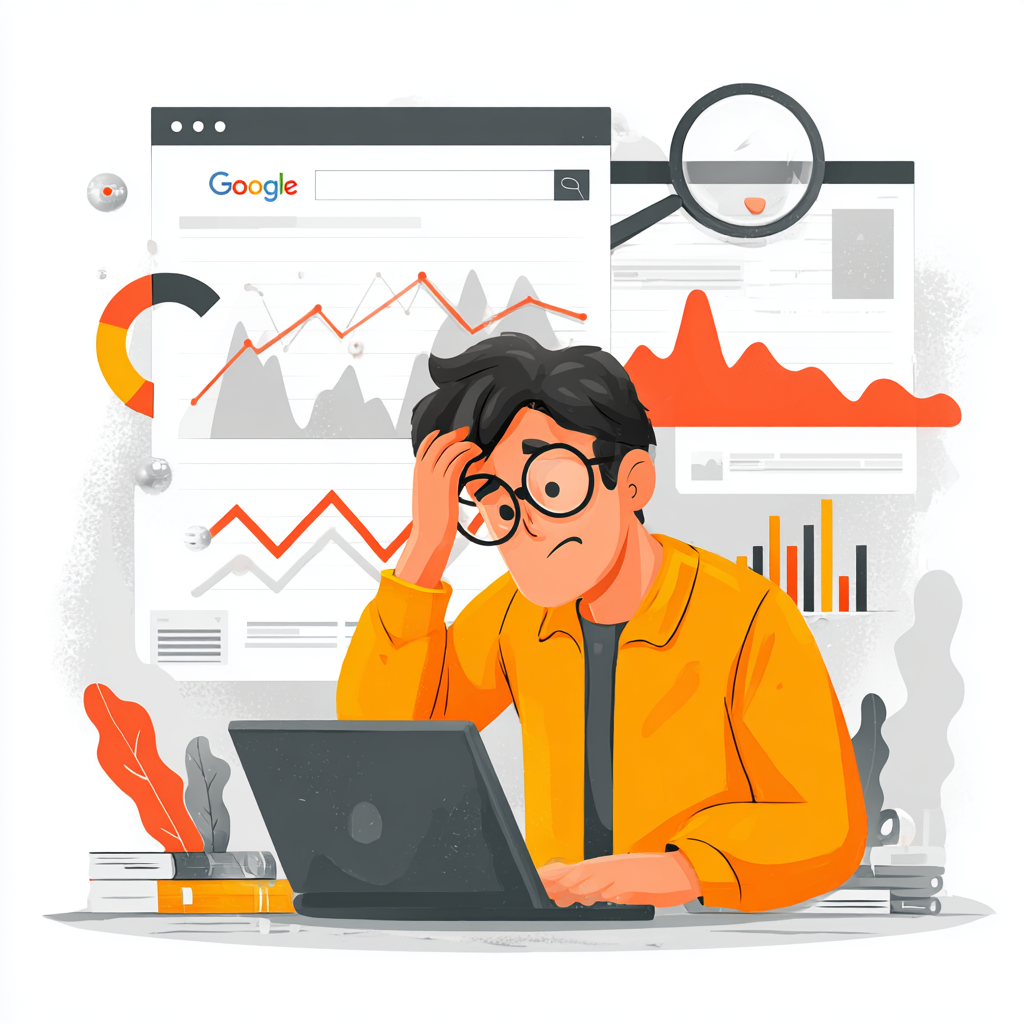
Your organic traffic just vanished. And you have no idea why.
Your rankings look fine. Your content strategy seems solid. But somehow, fewer people are clicking through to your website.
Welcome to what Darwin Santos brilliantly coined “The Great Decoupling.”
The Rules of SEO Just Broke
For decades, SEO followed predictable patterns. Higher rankings meant more visibility. More visibility meant more clicks. More clicks meant more traffic.
That relationship just died.
Recent data from Ahrefs reveals a devastating truth. When AI Overviews appear in search results, click-through rates for the top position drop by 34.5%.
Think about that for a moment.
You can rank number one and still lose over a third of your potential traffic. The connection between being found and being visited has completely severed.
The Numbers Tell a Brutal Story
I’ve been analyzing the data behind this shift, and the scope is staggering.
SparkToro’s research shows that over 58% of Google searches now result in zero clicks. Users find what they need without ever leaving Google’s ecosystem.
This means most searches never generate website visits at all.
Advanced Web Ranking found that AI Overviews now appear in more than 50% of all search results. That’s double the rate from just ten months ago.
The math is simple but brutal. More AI Overviews equals fewer clicks to your website.
What “The Great Decoupling” Really Means
Darwin Santos defined this phenomenon perfectly. Clicks and impressions have become decoupled from one another.
One can grow while the other declines.
This breaks one of the few hard-and-fast rules that SEO professionals have relied on for years. The assumption that visibility leads to visits no longer holds true.
Tom Capper, Senior Search Scientist at Moz, has been investigating this shift extensively. His research compares AI Overview prevalence across industries, geographic locations, and search intent stages.
What he’s finding challenges everything we thought we knew about search behavior.
The Quality vs Quantity Trade-Off
Here’s where the story gets interesting.
While overall traffic drops, the traffic that does come through performs differently. Recent data suggests visits from AI search convert 23 times better than visits from traditional search.
This creates a fascinating paradox. You get fewer visitors, but they’re significantly more qualified.
Some companies are adapting faster than others. HubSpot reportedly saw an 80% drop in organic traffic but still achieved 21% revenue growth in 2024.
The lesson? Volume and value don’t always correlate.
Why Most Businesses Are Getting This Wrong
The instinct is to fight AI Overviews. To try optimizing your way back to the old click-through rates.
That’s like trying to optimize for dial-up internet in a broadband world.
The fundamental infrastructure of search has changed. AI systems process, prioritize, and present information differently than traditional search engines.
Most businesses are still playing by the old rules while the game has completely changed.
The Strategic Shift That Changes Everything
SEO is no longer just about traffic. It’s about presence.
Success means showing up in snippets, product panels, AI answers, and video features. Fewer clicks don’t necessarily mean failure.
Sometimes they mean your content is working exactly as intended.
As industry expert Ryan Jones notes, “It’s not about the query anymore. It’s about semantic relevance to the topic.”
The future belongs to brands that get cited and mentioned wherever, whenever, and however possible.
What This Means for Your Business
The Great Decoupling represents more than a temporary algorithm change.
It signals a fundamental restructuring of how people discover and consume information online. Gartner predicts traditional search volume will drop 25% by 2026.
The businesses that thrive will be those that adapt their strategies now.
This means shifting focus from driving clicks to building authority. From ranking pages to creating notable, trustworthy brands that AI systems cite and reference.
The Path Forward
Understanding The Great Decoupling is the first step toward adapting to it.
The second step is recognizing that your old metrics might be measuring the wrong things. Traffic volume matters less than traffic quality and brand mentions across AI powered search features.
The third step is building content strategies that work within this new reality rather than fighting against it.
Will you adapt to The Great Decoupling, or will you keep optimizing for a world that no longer exists?
The choice is yours. But the clock is ticking.

 MarketMagnetix Media Group Insights
Leave a comment