
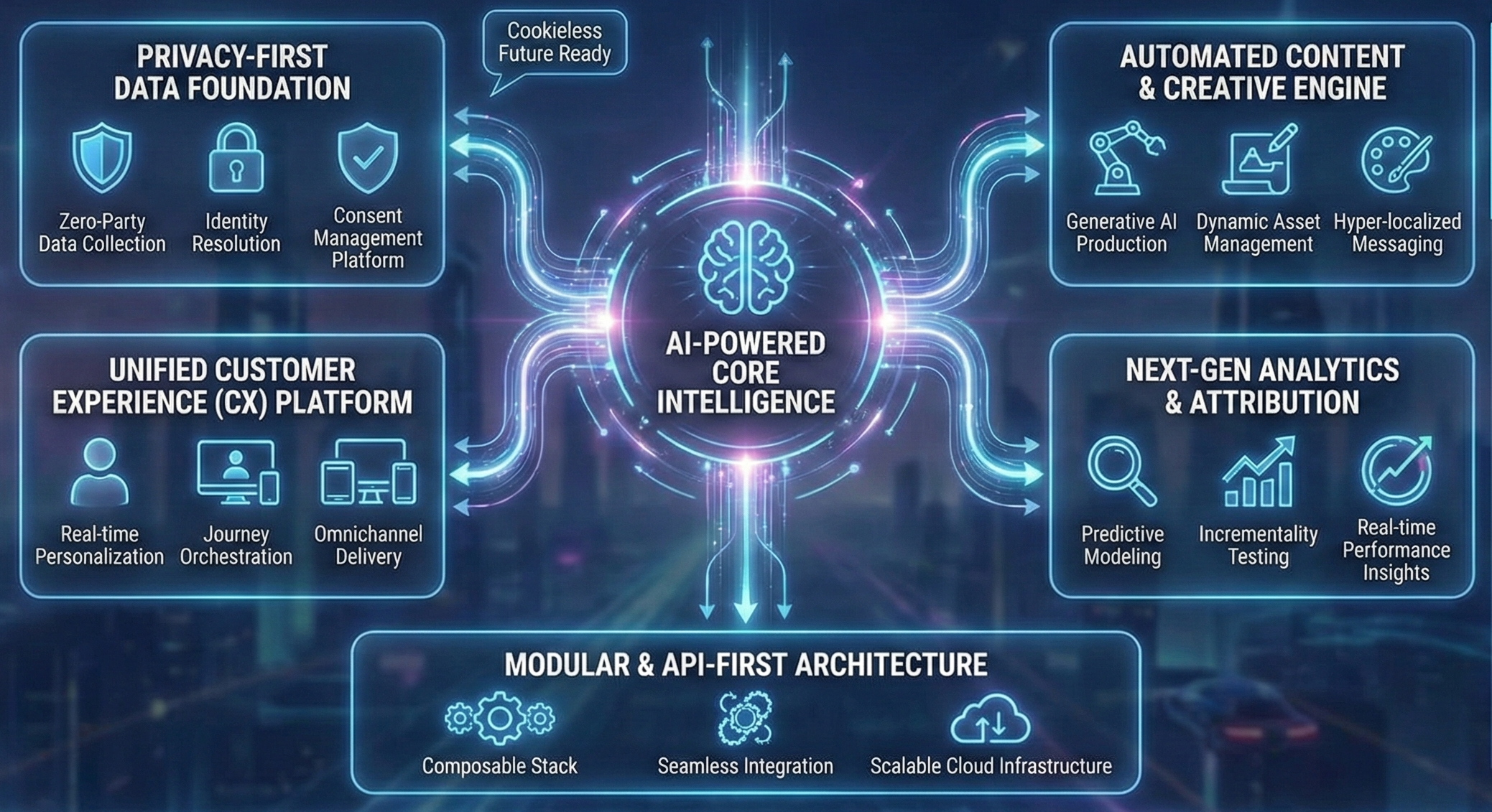
TL;DR: In 2026, winning marketing teams will run on AI agent infrastructure that completes transactions without human intervention. The traditional marketing funnel is compressing, SEO is shifting to topical authority, and brand citations are replacing backlinks. Teams that delay this transition risk falling permanently behind.
What Marketing Infrastructure You Need by 2026:
-
AI agents that can make decisions and complete transactions independently (not just chatbots)
-
Topical authority across subject areas instead of keyword-focused SEO strategies
-
Brand citations in trusted sources that AI models reference
-
Marketing teams with embedded engineers to build automated workflows and API integrations
-
Compressed funnel metrics focused on pipeline rather than traditional MQL qualification stages
What Is Agentic AI and Why Does It Matter for Marketing?
I’ve been watching something shift in digital marketing over the past 18 months.
It’s a fundamental change in how marketing operations work.
In 2026, the teams winning in digital marketing won’t be the ones with the best campaigns. They’ll be the ones who rebuilt their infrastructure around AI agents that can make decisions and complete transactions without human intervention.
How AI Agents Are Moving From Conversation to Commerce
Large language models started as chat interfaces. Ask a question, get an answer.
That’s changing fast.
Model API spending jumped from $3.5 billion to $8.4 billion in less than a year. But here’s what matters more: these systems now connect directly to inventory systems, payment gateways, and product catalogs.
They’re not just talking anymore. They’re transacting.
OpenAI and Stripe introduced the Agentic Commerce Protocol in 2025. This standard lets AI systems complete secure, auditable transactions from conversational intent.
The process works like this:
-
You tell an AI agent what you need
-
It handles the entire purchase process
-
No website visit required
-
No traditional funnel
-
Intent to conversion happens in minutes
Bottom line: AI agents are becoming transaction endpoints, not just information sources.
Why Is the Traditional Marketing Funnel Breaking Down?
I know this sounds dramatic, but the data backs it up.
Gartner found that 50% of companies using generative AI will start agentic AI pilot programs in 2025. These aren’t passive tools waiting for instructions. They’re systems that decide and act independently, pursuing complex goals with minimal supervision.
What Happens to Your Funnel When AI Agents Scale Lead Engagement?
MQLs become vanity metrics because AI SDR agents can engage with every single lead instead of just “top tier” ones. This changes the entire qualification process.
The evidence is compelling:
-
One company had 60% of leads not followed up because they weren’t considered top accounts. After implementing an AI SDR to work those leads, they saw a 130% increase in meetings booked.
-
Quantum Metric found visitors who engaged with their AI SDR agent were 8x more likely to book a meeting.
The funnel isn’t optimizing anymore. It’s compressing.
Key insight: When AI agents can engage every lead at scale, traditional qualification stages collapse and pipeline becomes the primary metric.
How Is SEO Changing Because of AI Search?
Search is changing because of how AI processes information.
Keywords still matter, but they’re now part of a larger topic ecosystem. AI search platforms like ChatGPT, Claude, and Google’s AI Overviews don’t rank individual pages for specific terms. Instead, they evaluate your topical authority across an entire subject area.
What Is Topical Authority and How Do You Build It?
Here’s the shift: SEO moved from a keyword-based discipline to a user-based discipline.
Building topical authority means publishing quality content on relevant topics consistently. When you establish this authority, you rank for more keywords in traditional search engines and appear for more prompts in AI tools.
Therefore, your content strategy must focus on:
-
Depth across subject areas, not just breadth
-
Consistent publishing on relevant topics
-
Comprehensive coverage that demonstrates expertise
The strategic shift: Topical authority determines visibility in both traditional search engines and AI-powered search tools.
Why Are Brand Citations Replacing Backlinks?
If your brand isn’t mentioned in trusted media sources, AI search may overlook you entirely.
Here’s the contrast:
-
Traditional search engines relied on backlinks as votes of confidence
-
AI systems rely on brand citations as signals of credibility and relevance
This changes your content strategy. You’re not just building links anymore. You’re building presence in the sources that AI models trust and reference.
What this means: Your PR and content distribution strategy directly impacts AI search visibility because citations in trusted sources signal authority to AI models.
Why Do Marketing Teams Need Engineers Now?
I’ve talked to dozens of marketing leaders over the past year. And just like us, the ones preparing for 2026 are embedding engineers directly into their marketing teams.
Why?
Because marketing is becoming a systems-thinking discipline. You’re not running one-off campaigns anymore. You’re building automated content pipelines, connecting APIs, and creating workflows where AI agents handle repetitive tasks.
What Does the Future Marketing Team Structure Look Like?
The future team structure works like this: marketers, engineers, and AI agents working together.
-
Marketers provide strategy and creative direction
-
Engineers build the infrastructure
-
AI agents execute at scale
Core principle: Marketing becomes infrastructure building, not just campaign execution, therefore requiring technical expertise embedded in the team.
What Are the Risks of Waiting Too Long?
Here’s what keeps me up at night for teams that delay this transition.
Within 24 months, you might face a marketplace where algorithmic intermediaries place orders, negotiate pricing, and filter brand messages before humans see them.
What Advantages Will Early Adopters Have Over Late Movers?
Your competitors who adapted early will have:
-
AI agents working leads you can’t reach
-
Transaction endpoints where you still have contact forms
-
Topical authority where you’re still chasing keywords
The gap between early adopters and late movers is widening faster than any shift I’ve seen in 20 years of following marketing strategies.
The urgency: The competitive gap created by AI infrastructure adoption is accelerating faster than previous marketing technology shifts.
What Can You Do Right Now to Prepare?
You don’t need to rebuild everything overnight. But you do need to start.
Five Steps to Start Building AI-Ready Marketing Infrastructure
1. Start with one pilot program.
Pick a repetitive workflow in your marketing operation and test an AI agent to handle it. Lead follow-up is a good place to begin.
2. Audit your content for topical authority.
Map out the subject areas where you want to be known. Identify gaps in your coverage. Build a content plan that establishes depth, not just breadth.
3. Get engineers involved in marketing planning.
Even if it’s just one person part-time, you need technical thinking embedded in your strategy discussions.
4. Track brand citations.
Monitor where your brand appears in trusted sources. Build relationships with publications and platforms that AI models reference.
5. Rethink your funnel metrics.
If AI agents can engage every lead, what actually matters? Pipeline becomes the focus, not arbitrary qualification stages.
Action plan: Start with one pilot program in a repetitive workflow, then expand infrastructure systematically across marketing operations.
What Will Separate Winning Teams From Losing Teams in 2026?
The teams that thrive in 2026 won’t be the ones with the best ads or the cleverest copy.
They’ll be the ones who:
-
Built infrastructure to let AI agents work alongside humans
-
Established topical authority before everyone else caught on
-
Adapted measurement systems to match how buyers move through compressed decision cycles
This isn’t about replacing marketers with machines. It’s about giving marketers leverage they’ve never had before.
The question isn’t whether this shift is coming. It’s whether you’ll be ready when it arrives.
What’s your next move?
Frequently Asked Questions About AI Marketing Infrastructure
What is the difference between AI chatbots and AI agents?
AI chatbots respond to user questions with information. AI agents make independent decisions and complete transactions without human intervention. Agentic AI can connect to inventory systems, payment gateways, and product catalogs to complete purchases from conversational intent.
How much does it cost to implement AI agents in marketing?
Model API spending jumped from $3.5 billion to $8.4 billion in less than a year, but individual teams can start with pilot programs focused on single workflows like lead follow-up. You don’t need to rebuild everything overnight—start with one repetitive marketing workflow to test ROI.
Will AI agents replace marketing teams?
No. The future marketing team structure combines marketers (strategy and creative direction), engineers (infrastructure building), and AI agents (execution at scale). This gives marketers leverage they’ve never had before rather than replacing them.
How do I build topical authority for AI search?
Building topical authority requires publishing quality content on relevant topics consistently. Map out subject areas where you want to be known, identify coverage gaps, and create content that establishes depth across entire topic ecosystems rather than targeting individual keywords.
What are brand citations and why do they matter?
Brand citations are mentions of your brand in trusted media sources. AI systems use brand citations as signals of credibility and relevance, similar to how traditional search engines used backlinks. If your brand isn’t cited in sources that AI models trust, AI search may overlook you entirely.
What is the Agentic Commerce Protocol?
The Agentic Commerce Protocol is a standard introduced by OpenAI and Stripe in 2025 that lets AI systems complete secure, auditable transactions from conversational intent. It enables AI agents to handle entire purchase processes without requiring website visits or traditional funnels.
How quickly is the gap widening between early adopters and late movers?
According to Gartner, 50% of companies using generative AI will start agentic AI pilot programs in 2025. Within 24 months, algorithmic intermediaries may place orders, negotiate pricing, and filter brand messages. The gap is widening faster than any marketing technology shift in the past 20 years.
Should I stop focusing on traditional SEO keywords?
No. Keywords still matter, but they’re now part of a larger topic ecosystem. AI search platforms like ChatGPT, Claude, and Google’s AI Overviews evaluate topical authority across entire subject areas rather than ranking individual pages for specific terms. Focus on building comprehensive topical coverage while maintaining keyword optimization.
Key Takeaways
-
AI agents are becoming transaction endpoints: By 2026, AI systems will complete purchases from conversational intent using protocols like the Agentic Commerce Protocol, bypassing traditional websites and funnels.
-
The marketing funnel is compressing: When AI SDR agents can engage every lead at scale, traditional MQL qualification becomes obsolete and pipeline becomes the primary metric (companies see 130% increases in meetings booked and 8x higher conversion rates).
-
SEO is shifting from keywords to topical authority: AI search platforms evaluate comprehensive expertise across subject areas rather than ranking individual pages, making consistent, in-depth content essential for visibility.
-
Brand citations replace backlinks as ranking signals: AI systems use mentions in trusted sources as credibility signals, making PR and content distribution strategies critical for AI search visibility.
-
Marketing teams need embedded engineers: Marketing is becoming infrastructure building (automated pipelines, API integrations, AI agent workflows) rather than just campaign execution, requiring technical expertise.
-
The competitive gap is accelerating: Early adopters are building advantages (AI-powered lead engagement, transaction endpoints, topical authority) faster than any previous marketing technology shift over the past 20 years.
-
Start with pilot programs now: You don’t need to rebuild everything overnight—begin with one repetitive workflow, audit topical authority, embed technical thinking, track brand citations, and rethink funnel metrics.

 MarketMagnetix Media Group Insights
Leave a comment