
I started noticing something strange in my analytics last year.
Traffic was coming from sources I couldn’t identify. Sessions that Google Analytics labeled as “direct” but behaved nothing like direct traffic. Visitors who spent 9+ minutes on pages that typically got 3-4 minutes of attention.
Then I realized what was happening.
AI platforms were sending me traffic, and my tracking systems had no idea how to categorize it.
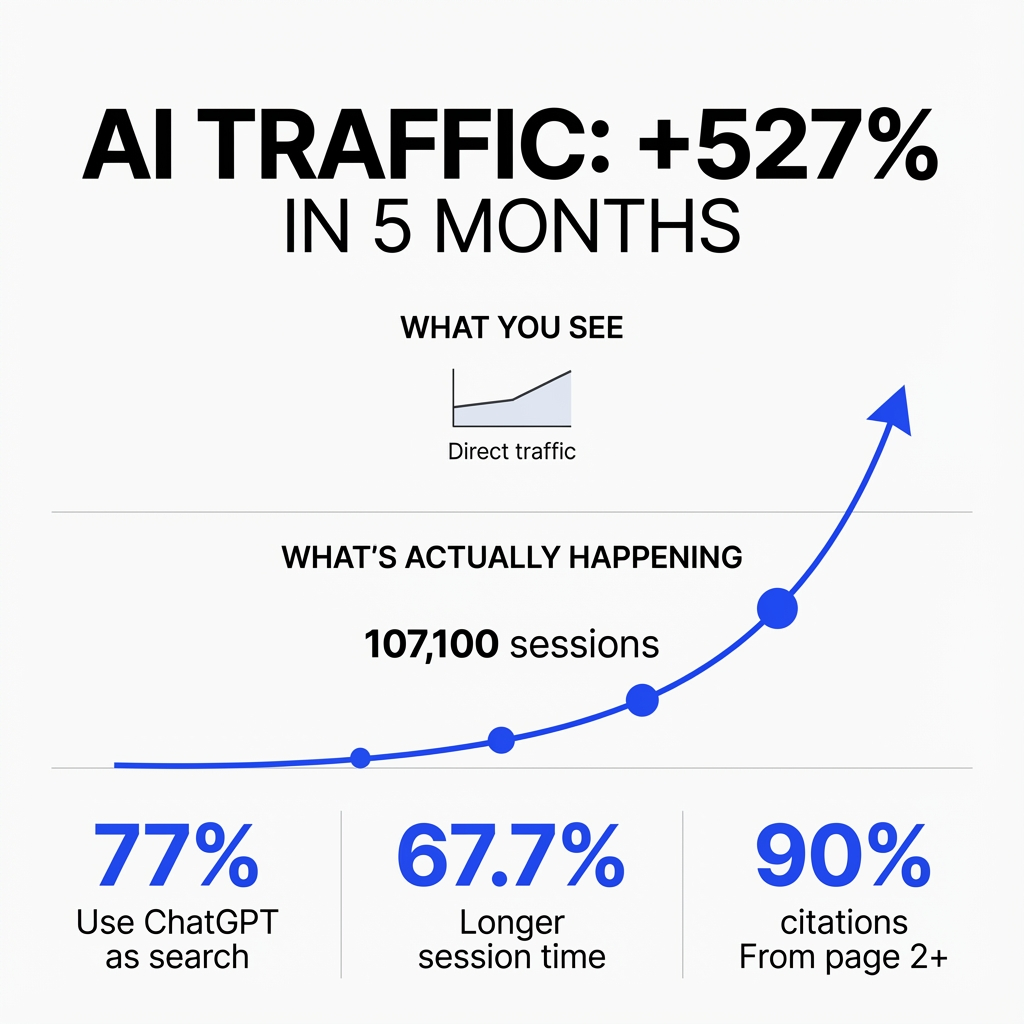
I’m not alone. Between January and May 2025, AI-sourced traffic jumped 527% year-over-year across analyzed properties. We’re talking about a leap from 17,076 sessions to 107,100 sessions in just five months.
This isn’t a trend. It’s a structural shift in how people find information online.
The Google Monopoly Is Actually Breaking
For the first time since 2015, Google’s global search share has dipped below 90% in most of 2025.
Let that sink in.
Google has dominated search for two decades. Now Bing, Yandex, and AI-native tools like ChatGPT Search are taking meaningful chunks of that market.
The numbers tell the story: 77% of Americans now use ChatGPT as a search engine. Not as a writing tool. Not as a curiosity. As their primary method for finding information.
24% of people choose ChatGPT before they even consider Google.
ChatGPT commands 17% of digital queries globally. That’s not a rounding error. That’s the biggest threat to Google’s dominance in 20+ years.
The Traffic Quality Difference Is Dramatic
Here’s what surprised me most when I dug into the data.
Visitors arriving from AI platforms spend 67.7% more time on sites than those coming from organic search results.
We’re talking about 9 minutes and 19 seconds compared to 5 minutes and 33 seconds for Google and other search engines.
This isn’t just longer sessions. It’s better sessions.
AI platforms are delivering more qualified, high-intent users who actually engage with content. Claude users have the highest session value at $4.56 per visit. Perplexity follows at $3.12.
Compare that to the average organic search visit, and you start to understand why this matters.
Bottom-of-Funnel Traffic Moves First
I’ve watched this pattern repeat across industries.
The traffic shifting to AI platforms first is bottom-of-funnel. People asking specific questions. Looking for expert advice. Ready to make decisions.
Legal, Finance, Health, SMB, and Insurance now account for 55% of all LLM-sourced sessions. These are high-consultive industries where people need answers they can trust.
Transactional and branded searches remain the least affected by AI. That makes sense. If you’re searching for “Nike shoes size 10,” you want a product page, not a conversation.
But if you’re asking “What business structure protects me best as a freelance consultant?” you want expertise. And AI platforms deliver that in a format that feels natural.
Your Attribution Models Are Lying to You
Here’s the part that keeps me up at night.
Almost 90% of ChatGPT’s citations come from search results ranking in positions 21+.
Not the top 5 rankings you’re fighting for. Not even the first page.
The entire SEO playbook assumes visibility equals ranking. But AI platforms don’t care about your ranking. They care about your content’s usefulness in answering a specific question.
ChatGPT’s CFO Sarah Friar noted that traditional search metrics undercount AI because conversational queries often involve five or six back-and-forth turns but get logged as a single session.
You might appear in hundreds of AI answers and never see a traffic signal in Google Analytics or Search Console.
Your best content could be driving massive value, and you’d have no idea.
The Multi-Platform Reality Nobody Prepared For
ChatGPT dominates with 77.97% of all AI traffic visits right now.
But Perplexity holds 1.5%, Google’s AI tools claim 5.6%, and other platforms are gaining traction fast.
I’ve seen brands ranking on Google’s first page appear in ChatGPT answers 62% of the time. That’s a clear but incomplete overlap.
Traditional SEO success doesn’t guarantee AI visibility.
This creates a massive opportunity for competitive disruption. Early adopters are already experimenting with how to shape generative answers.
Just as first movers in SEO once dominated search results, the brands that adapt quickly will capture an outsized share in LLM-driven recommendations.
The Revenue Impact Is Already Here
McKinsey projects that AI-powered search could impact $750 billion in revenue by 2028.
Half of consumers are using AI-powered search today. 44% say it’s their primary and preferred source of insight, topping traditional search at 31%.
About 50% of Google searches already have AI summaries. That figure is expected to rise to more than 75% by 2028.
This isn’t a future problem. It’s happening now.
What I’m Doing Differently Now
I’ve changed how I think about content discovery.
I’m not optimizing for ranking anymore. I’m optimizing for selection.
That means structuring content so AI platforms can easily extract and cite it. Using clear headings, scannable formats, and direct answers to specific questions.
I’m tracking AI traffic separately now. Custom UTM parameters, dedicated segments in analytics, manual monitoring of citations in ChatGPT and Perplexity.
I’m building trust architecture into every piece of content. Author credentials, source citations, clear expertise signals that AI platforms can recognize and value.
I’m treating every content asset as discovery-eligible. Not just blog posts. Product pages, FAQs, case studies, even customer support documentation.
The Early Mover Window Is Closing
Here’s what concerns me most.
The brands that figure this out first will establish authority that’s hard to displace. AI platforms are building preference models based on which sources consistently deliver accurate, useful information.
Once those preferences solidify, breaking in gets harder.
We’re seeing winner-take-most dynamics emerge. The same way Google’s algorithm created dominant players in every niche, AI platforms are creating new hierarchies of trusted sources.
If you’re waiting for this to stabilize before you adapt, you’re already behind.
The Conversation Interface Advantage
I’ve started thinking about content differently.
Not as pages to rank, but as answers to questions people actually ask.
AI platforms favor brands that structure information in dialogue-compatible formats. That means anticipating follow-up questions, addressing objections, providing context.
It means writing like you’re having a conversation, not delivering a lecture.
The brands winning in this new landscape are the ones that sound like trusted advisors, not corporate marketing departments.
What This Means for You
I can’t tell you exactly how to optimize for AI platforms in the future. Nobody can, because the systems are still evolving.
But I can tell you what I’m watching.
Track your unattributed traffic spikes. Those 9-minute sessions from “direct” sources might be AI referrals.
Structure your content for extraction. Make it easy for AI to pull clear, accurate answers.
Build authority signals into everything you publish. Credentials, citations, expertise markers.
Think cross-platform. Optimize for usefulness, not just rankings.
The shift is already happening. The question isn’t whether AI platforms will change how people discover content.
The question is whether you’ll adapt before your competitors do.
Sources
[1] Previsible AI Traffic Report 2025 – Search Engine Land: AI traffic is up 527%. SEO is being rewritten. (August 2025)
[2] StatCounter Global Stats – Google vs AI search: is Google’s dominance fading? (December 2025)
[3] Adobe Express Survey – ChatGPT as a Search Engine (May 2025)
[4] First Page Sage Market Share Report – Google vs ChatGPT Market Share: 2025 Report (December 2025)
[5] Ahrefs Study – How LLM Traffic Is Growing (And Why It Matters for Analytics) (2025)
[6] Insightland Analysis – AI Search: traffic killer or the biggest opportunity yet? (November 2025)

 MarketMagnetix Media Group Insights
Leave a comment