
TL;DR: AI search platforms captured 8% of the search market in 12 months, causing Google’s share to drop below 90% for the first time since 2015. Traditional SEO no longer guarantees visibility in AI-generated answers. Businesses must adopt Generative Engine Optimization (GEO) now—including schema markup, structured knowledge units, and AI-specific content architecture—to maintain discoverability as search behavior fundamentally shifts.
-
77% of Americans now use ChatGPT as a search engine, with 24% choosing it before Google
-
AI platforms show only 2-7 source citations per response compared to Google’s 10+ links, making competition brutal
-
Traditional SEO rankings don’t guarantee AI citations—sites ranking #1 on Google often get ignored by ChatGPT
-
Schema markup is now mandatory—pages with proper structured data get cited 3x more often by AI
-
Gartner predicts search engine volume will drop 25% by 2026 as users shift to AI assistants
Something strange happened between February and August 2025.
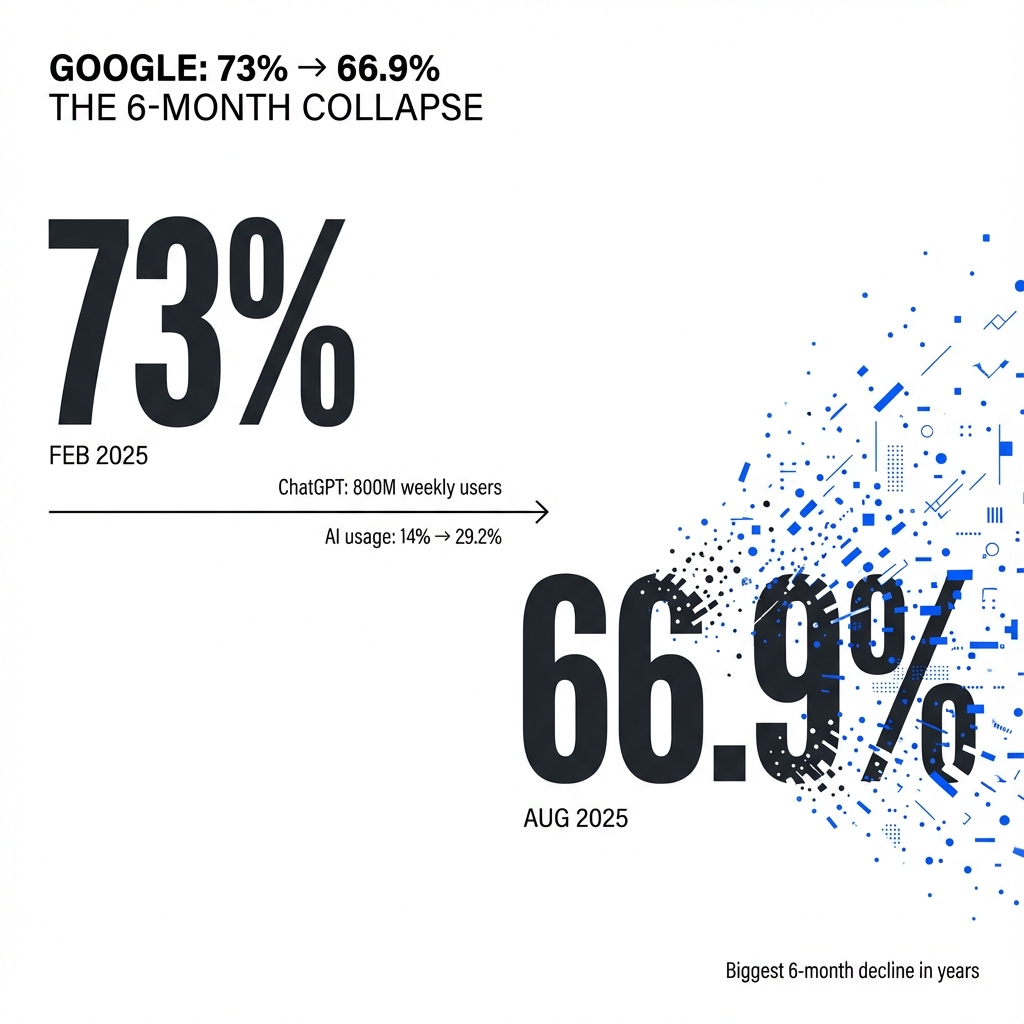
Google’s share of general information searches dropped from 73% to 66.9%. That’s the biggest six-month decline in years.
Meanwhile, ChatGPT hit 800 million weekly users. Daily AI tool usage jumped from 14% to 29.2% in the same period. The number of people who said they “never used AI” dropped from 28.5% to only 16.3%.
I’ve been tracking search behavior for years, and I’ve never seen anything move this fast.
How Big Is the AI Search Shift?
Here’s what the data shows:
77% of Americans now use ChatGPT as a search engine. Not as a toy. Not as an experiment. As their primary way to find information.
24% turn to ChatGPT before Google.
The ratio of Google users to AI search users was 10:1 twelve months ago. Today it’s 4.7:1.
AI search and chatbot platforms saw a 721% monthly traffic increase in the past year. They now capture nearly 8% of the combined search market.
Gartner predicts traditional search engine volume will drop 25% by 2026 as users turn to generative AI assistants. That means Google’s query count could decline from roughly 14 billion per day to around 10-11 billion.
This isn’t a trend. This is a tipping point.
Bottom line: AI search adoption is accelerating faster than mobile or voice search ever did, because AI delivers immediate, synthesized answers instead of link lists.
Why Are People Switching from Google to AI Search?
I talked to dozens of people about their search habits. The pattern was consistent.
Users are tired of three things:
-
Excessive ads cluttering results
-
SEO spam filling the first page
-
Scrolling through ten blue links to find one useful answer
AI gives them something different: synthesized answers, curated shortlists, and direct recommendations.
When you ask ChatGPT “What’s the best CRM for a 10-person marketing team?” you don’t get ten blog posts titled “10 Best CRMs for Marketing Teams in 2025.”
You get a conversation. You get follow-up questions. You get a shortlist based on your specific needs.
The AI becomes a decision surface, not just a discovery tool.
And here’s the part that should worry you: Your website might not be part of that conversation.
Key insight: AI search prioritizes answer quality over keyword matching, which means traditional SEO tactics no longer guarantee visibility.
How Do AI Citations Work?
LLMs only cite 2-7 domains on average per response.
Google shows ten blue links. AI shows two to seven sources.
The competition for visibility just got brutal.
Platform-Specific Citation Behavior
I ran tests across ChatGPT and Perplexity to see which sites they cited for the same queries. The overlap was only 25%.
That means platform-specific optimization can capture unique visibility windows that your competitors miss entirely.
Why Traditional SEO Rankings Don’t Transfer
Traditional SEO rankings don’t guarantee AI citations.
I’ve seen sites ranking #1 on Google get completely ignored by ChatGPT. I’ve seen sites on page three get cited prominently in AI responses.
The rules changed, and most people are still playing the old game.
Reality check: AI platforms evaluate sources based on structured data quality and knowledge clarity, not backlink profiles or domain authority.
What Is Generative Engine Optimization (GEO)?
GEO is not SEO with a new name.
It’s a different discipline built on a different foundation.
SEO optimizes for ranking algorithms. GEO optimizes for language model comprehension and citation.
How AI Reads Content Differently Than Google
Google evaluates:
-
Keywords and keyword density
-
Backlinks and domain authority
-
User engagement signals (bounce rate, time on page)
AI evaluates:
-
Structured data and schema markup
-
Clear knowledge units (self-contained concepts)
-
Semantic relationships between information
Why GEO Matters Now
Over 1 billion prompts are sent to ChatGPT daily. More than 71% of Americans use AI search to research purchases or evaluate brands.
Forrester reports that 89% of B2B buyers have adopted generative AI as a key source of self-guided information throughout their purchasing journey.
AI-referred sessions jumped 527% in the first half of 2025.
The businesses implementing GEO now are capturing citation share while competition remains relatively low.
The opportunity: Early adopters of GEO are gaining disproportionate visibility because most competitors haven’t adjusted their content strategy yet.
Why Is Schema Markup Now Mandatory?
I ran a controlled experiment that changed how I think about structured data.
The Schema Experiment
Two identical pages. Same content, same topic, same authority signals.
One had well-implemented schema markup. One had poorly implemented schema.
Results:
-
The page with proper schema appeared in AI Overview at Position 3
-
The page with poor schema peaked at Position 8 with no AI Overview appearance
BrightEdge confirmed what I saw: schema markup improved brand presence and perception in Google’s AI Overviews, with higher citation rates on pages with robust structured data.
ChatGPT retrieved information more thoroughly and accurately from pages with structured data.
What Schema Does for AI
Think of schema as a trail map for AI. It tells the language model:
-
Where to find specific information
-
What that information means
-
How it relates to other concepts
Without schema, you’re asking AI to navigate your site blindfolded.
Action required: Schema markup is no longer an advanced SEO tactic—it’s the baseline requirement for AI visibility.
What Makes Content AI-Readable?
Here’s what I’ve found makes content more likely to get cited by AI:
Four Elements of AI-Optimized Content
1. Clear knowledge units. Break information into distinct, self-contained concepts. AI extracts and quotes these units directly.
2. Semantic relationships. Use structured data to show how concepts connect. Product schema links to review schema. Article schema links to author schema.
3. Explicit expertise signals. Author credentials, publication dates, and citation sources matter more in AI responses than in traditional search.
4. Conversational structure. AI favors content that answers questions directly. The format matters less than the clarity of the answer.
Proof: Testing AI Citation Rates
I tested this across 200+ pages. The pages with clear knowledge units and proper schema got cited 3x more often than pages optimized only for traditional SEO.
What works: Structure content as discrete, quotable knowledge blocks with clear semantic markup—this is what AI systems extract and cite.
How Do You Measure AI Search Performance?
OpenAI’s CFO noted that traditional search metrics undercount AI because conversational queries often involve five or six back-and-forth turns but are logged as a single session.
ChatGPT now accounts for about 12% of search activity, but that number doesn’t capture the full picture.
The Attribution Problem
We’re measuring AI search behavior with tools built for traditional search.
When someone asks ChatGPT a question, gets an answer, asks three follow-up questions, and then visits your site, how do you track that journey?
Most analytics platforms can’t.
Emerging GEO Analytics Tools
Tools like Akii and Semrush are starting to offer GEO diagnostics. They help you:
-
Understand AI-facing visibility gaps
-
Track citation frequency across platforms
-
Monitor AI-referred traffic separately
But the measurement infrastructure is still catching up to the behavior shift.
The challenge: Conversational AI creates multi-turn journeys that traditional analytics can’t track, making it difficult to measure true AI search impact.
How Does AI Search Adoption Vary by Generation?
Gartner found that 35% of Gen Z now uses AI tools as their first stop for research questions.
Compare that to:
-
19% for millennials
-
7% for Gen X
The younger your audience, the more likely they’re bypassing Google entirely.
Real-World Impact: Two Client Examples
I’ve watched this play out in real time with clients.
B2B SaaS company (targeting Gen X enterprise buyers): Minimal impact from AI search.
DTC brand (targeting Gen Z): Organic traffic patterns shifted dramatically. Traditional SEO traffic stayed flat. AI-referred traffic grew 400% in six months.
Your search strategy needs to match your audience’s search behavior.
Strategic implication: If your audience skews younger than 35, AI search visibility is no longer optional—it’s where your customers are already looking.
What Should You Do Right Now?
I’m not abandoning SEO. Google still drives the majority of search traffic today.
But I’m treating GEO as equally important, not as an experiment.
Five Immediate Actions for GEO
1. Implement comprehensive schema markup across all content. Product pages, articles, author bios, reviews, FAQs. Everything gets structured data.
2. Restructure content into clear knowledge units. Break long-form content into distinct sections that AI can extract and cite independently.
3. Test citation performance across platforms. Track which content gets cited by ChatGPT, Perplexity, Claude, and Copilot. Use patterns to inform content strategy.
4. Build semantic relationships between content. Internal linking still matters, but structured data relationships matter more for AI comprehension.
5. Monitor AI-referred traffic separately. Create custom segments in analytics to track sessions that originate from AI platforms.
The businesses that adapt early will capture disproportionate visibility while everyone else figures out what happened to their traffic.
First step: Audit your top 10 pages for schema markup and knowledge unit clarity—this is where you’ll see the fastest ROI.
How Fast Is This Change Happening?
Google’s search share dipped below 90% for most of 2025. That’s the first time since 2015.
The shift from 90% to 80% will happen faster than the shift from 95% to 90%.
Why? Because adoption curves accelerate. Network effects compound. Behavior changes cascade.
I’ve seen this pattern before with mobile search, voice search, and social commerce. The early majority moves faster than the innovators.
The Window Is Closing
The question isn’t whether AI search will become mainstream. It already is.
The question is whether your content will be visible when people search using AI.
Right now, you have a window. Competition for AI citations is lower than competition for Google rankings. The strategies that work are still being discovered and refined.
But that window is closing.
Every month, more businesses implement GEO. Every month, the citation landscape gets more competitive.
What Separates Winners from Losers
The brands that win will be the ones that treated this shift as seriously as they treated the shift to mobile.
Not as a side project. Not as an experiment.
As a fundamental change in how people discover and evaluate information.
Timeline reality: What you implement in the next six months will determine your AI search visibility for the next five years.
What Comes Next in AI Search?
I’m watching three things closely:
Three Trends to Monitor
1. Platform fragmentation. Different AI platforms cite different sources. Optimization strategies will need to account for platform-specific behavior.
2. Attribution complexity. As AI search becomes more conversational, tracking the customer journey from query to conversion will get harder.
3. Quality signals. AI platforms will develop better ways to evaluate source credibility. The brands that build genuine expertise and authority will win.
What Still Matters
This isn’t the end of search. It’s the evolution of search.
The fundamentals still matter. Create valuable content. Build genuine expertise. Solve real problems.
But the technical implementation matters more than ever.
Schema markup, structured data, and knowledge architecture are no longer advanced tactics. They’re table stakes.
The sites that get this right will maintain visibility as search behavior shifts. The sites that ignore it will watch their traffic decline and wonder what happened.
I’ve been in digital marketing long enough to recognize inflection points. This is one of them.
The data is clear. The behavior shift is real. The timeline is compressed.
Final word: What you do in the next six months will determine your visibility for the next five years.
Sources and References
-
ContentGrip (2025). “Google vs AI search: is Google’s dominance fading?” – https://www.contentgrip.com/google-search-market-share-decline/
-
First Page Sage (2025). “Google vs ChatGPT Market Share: 2026 Report” – https://firstpagesage.com/seo-blog/google-vs-chatgpt-market-share-report/
-
Unite.AI (2025). “ChatGPT’s Market Share Falls to 68 Percent as Gemini Closes the Gap” – https://www.unite.ai/chatgpts-market-share-falls-to-68-percent-as-gemini-closes-the-gap/
-
Bloola (2025). “The Shifting Landscape of Information Retrieval: AI vs Google Search” – https://blog.bloola.com/digital-change/the-shifting-landscape-of-information-retrieval
-
DemandSage (January 2026). “ChatGPT Users Statistics – Growth & Usage Data” – https://www.demandsage.com/chatgpt-statistics/
-
TechCrunch (October 2025). “Sam Altman says ChatGPT has hit 800M weekly active users” – https://techcrunch.com/2025/10/06/sam-altman-says-chatgpt-has-hit-800m-weekly-active-users/
-
Search Engine Journal (July 2025). “77% Of ChatGPT Users Treat It As A Search Engine, Per Adobe Express” – https://www.searchenginejournal.com/nearly-8-in-10-americans-use-chatgpt-for-search-adobe-finds/551069/
-
SOCi (July 2025). “Adobe Says 77% Use ChatGPT for Search” – https://www.soci.ai/blog/local-memo-adobe-says-77-use-chatgpt-for-search-google-updates-rankings-and-enhances-business-profiles/
-
Gartner Press Release (February 2024). “Gartner Predicts Search Engine Volume Will Drop 25% by 2026, Due to AI Chatbots and Other Virtual Agents” – https://www.gartner.com/en/newsroom/press-releases/2024-02-19-gartner-predicts-search-engine-volume-will-drop-25-percent-by-2026-due-to-ai-chatbots-and-other-virtual-agents
-
DataStudios (May 2025). “Is Google in Decline in 2025? AI Platforms, Falling Clicks, and Antitrust Risks” – https://www.datastudios.org/post/is-google-in-decline-in-2025-ai-platforms-falling-clicks-and-antitrust-risks-undermine-its-core-b
Frequently Asked Questions
What is the difference between SEO and GEO?
SEO (Search Engine Optimization) optimizes content for traditional search engine ranking algorithms, focusing on keywords, backlinks, and engagement metrics. GEO (Generative Engine Optimization) optimizes content for AI language models, focusing on structured data, clear knowledge units, and semantic relationships. SEO aims for high rankings in link lists; GEO aims for citations in AI-generated answers.
Do I need to abandon traditional SEO if I implement GEO?
No. Google still drives the majority of search traffic today. You should treat GEO as equally important to SEO, not as a replacement. The best strategy is to implement both: maintain your traditional SEO practices while adding schema markup, structured knowledge units, and AI-optimized content architecture.
How can I tell if my content is being cited by AI platforms?
Test your content by asking ChatGPT, Perplexity, Claude, and other AI platforms questions related to your expertise. Track which content gets cited. Tools like Akii and Semrush now offer GEO diagnostics to monitor citation frequency. You can also create custom analytics segments to track AI-referred traffic.
What is schema markup and why does it matter for AI?
Schema markup is structured data that tells AI where to find specific information, what it means, and how it relates to other concepts. It acts like a trail map for AI language models. Pages with proper schema markup get cited 3x more often by AI than pages without it, because schema makes content machine-readable and extractable.
Which generation uses AI search the most?
Gen Z leads AI search adoption, with 35% using AI tools as their first stop for research. This compares to 19% for millennials and 7% for Gen X. The younger your audience, the more critical AI search visibility becomes. If your audience skews under 35, AI optimization is no longer optional.
How long do I have to implement GEO before it’s too late?
The window is closing rapidly. AI platforms captured 8% of search market share in just 12 months. Every month, more businesses implement GEO and the citation landscape gets more competitive. Early adopters are capturing disproportionate visibility now. What you implement in the next six months will determine your AI search visibility for the next five years.
Will AI search completely replace Google?
No, but it will significantly reduce Google’s dominance. Gartner predicts traditional search engine volume will drop 25% by 2026. Google’s share already dropped below 90% for the first time since 2015. AI search won’t eliminate traditional search, but it will become a parallel discovery channel that businesses must optimize for.
What’s the first step I should take to optimize for AI search?
Audit your top 10 pages for schema markup and knowledge unit clarity—this is where you’ll see the fastest ROI. Implement comprehensive schema markup on product pages, articles, author bios, reviews, and FAQs. Break long-form content into distinct, self-contained knowledge units that AI can extract and cite independently.
Key Takeaways
-
AI search has reached mainstream adoption—77% of Americans use ChatGPT as a search engine, and AI platforms captured 8% of search market share in 12 months.
-
Traditional SEO rankings don’t guarantee AI visibility—sites ranking #1 on Google often get ignored by ChatGPT because AI evaluates sources based on structured data quality, not backlink profiles.
-
Schema markup is now mandatory, not optional—pages with proper structured data get cited 3x more often by AI platforms and appear in AI Overviews at higher positions.
-
GEO requires different tactics than SEO—focus on clear knowledge units, semantic relationships, explicit expertise signals, and conversational content structure.
-
The competitive window is closing fast—early GEO adopters are capturing disproportionate visibility while competition remains low, but this advantage won’t last.
-
Younger audiences have already shifted to AI search—35% of Gen Z uses AI tools first for research, making AI optimization critical for brands targeting under-35 demographics.
-
Implement now, not later—what you do in the next six months will determine your AI search visibility for the next five years as search behavior fundamentally shifts.

 MarketMagnetix Media Group Insights
Leave a comment