
I’ve spent the last few months tracking something strange.
Two of my clients published content on the exact same topic. Same audience. Same keyword targets. But wildly different optimization strategies.
Client A optimized for featured snippets. Client B focused on becoming a cited source for AI models.
After launch, Client A crushed it. Immediate traffic spike. Featured snippet locked in. High fives all around.
Client B? Crickets. Almost zero traffic.
Then something weird happened.
Six months later, Client B’s content started appearing everywhere that mattered: ChatGPT responses, Perplexity summaries, Google’s AI Overviews. Their brand recognition exploded.
Meanwhile, Client A watched their traffic plummet 40% as zero-click searches devoured their visibility.
That’s the moment it hit me.
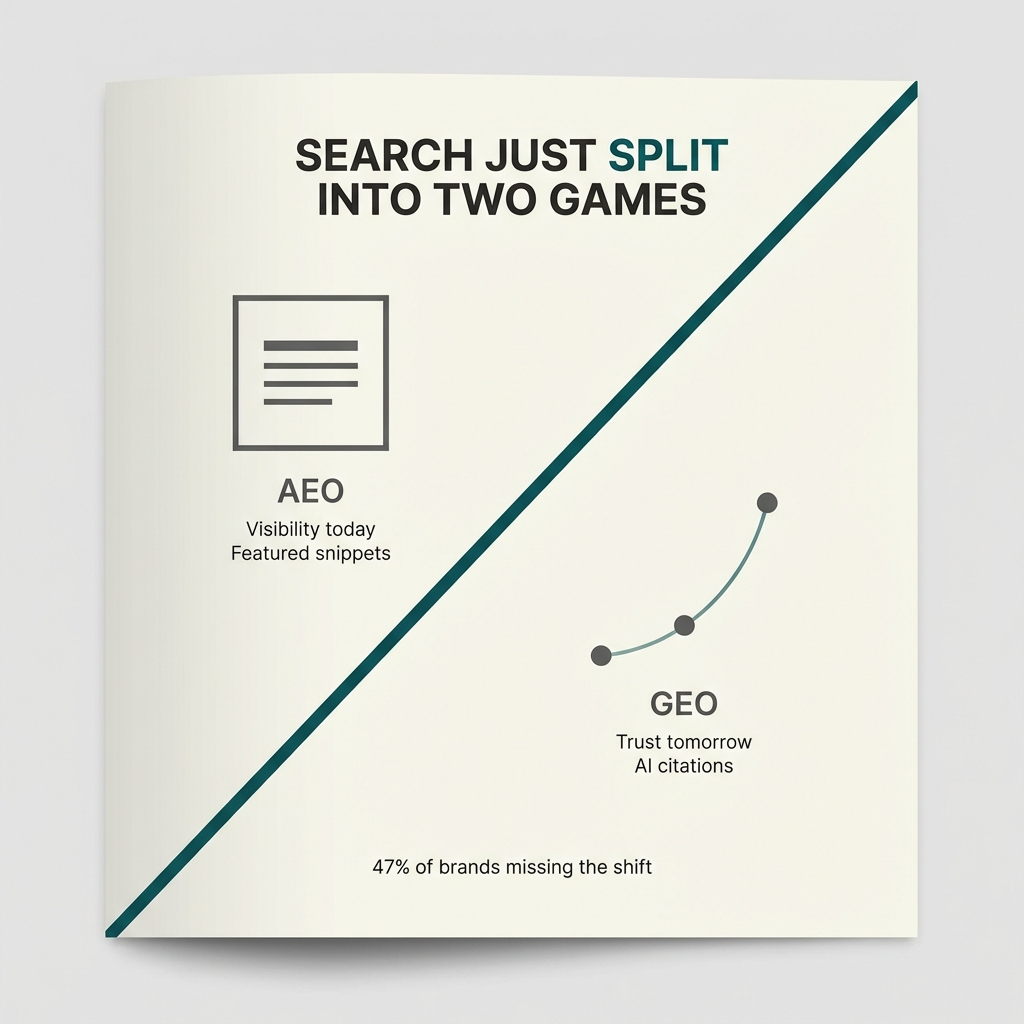
We’re not optimizing for search anymore. We’re playing two completely different games with two completely different rulebooks.
The Search Engine Just Became Two Separate Platforms
Answer Engine Optimization (AEO) and Generative Engine Optimization (GEO) sound like marketing jargon dreamed up by consultants who bill by the acronym.
They’re not.
They represent a fundamental split in how search actually works now. And understanding the difference is the only way to stay visible.
AEO is the old game. You optimize content to appear in featured snippets, knowledge panels, and quick answers. The strategy is simple: Give Google a clean 40-60 word answer it can extract and display at the top of search results. You win when users see your content without ever clicking through to your site.
GEO is the new game. You optimize to become a trusted source that AI models cite when they generate answers. You want ChatGPT, Perplexity, and AI Overviews to reference your content as authoritative. You win when AI systems trust you enough to quote you repeatedly.
Think the difference doesn’t matter?
According to recent market analysis, ChatGPT now commands 17% of all search queries. That’s the biggest threat to Google’s dominance in over 20 years.
Here’s the kicker: AI search platforms hold 12-15% of global search market share as of 2025.
You can’t pick one game and ignore the other. Not anymore.
Why AEO and GEO Require Completely Different Content Strategies
I used to think optimizing for one would naturally cover the other.
Wrong.
Dead wrong.
AEO wants you to answer specific questions with surgical precision. Structure your content with crystal-clear headings. Use schema markup. Put your absolute best answer in the first 40-60 words. Make it stupidly easy for Google to extract and display your content.
The AEO goal? Immediate visibility for high-intent queries.
GEO wants something totally different. It wants you to establish deep, undeniable expertise. Publish original research nobody else has. Include author credentials that prove you know what you’re talking about. Cite reputable sources. Create content so authoritative that AI models treat you as a primary reference.
The GEO goal? Become a trusted source AI systems cite over and over again.
Now here’s where it gets interesting.
Research shows that including citations and statistics can boost source visibility by over 40% in AI-generated responses.
Sounds great, right?
Except LLMs only cite 2-7 domains on average per response. That’s a massive reduction from Google’s traditional 10 blue links.
Translation: The competition for authority just became absolutely brutal.
The Zero-Click Problem Nobody Wants to Talk About
More than half of Google searches now end without a click.
Let that sink in for a second.
Users get their answer from a featured snippet, knowledge panel, or AI summary. They never visit your site. Never see your brand. Never enter your funnel.
This creates a weird paradox that should terrify traditional SEO folks.
You optimize content. You win the ranking. Your answer shows up prominently. Users get exactly what they need. They don’t click. You get zero traffic.
Congratulations?
Traditional SEO metrics break down completely in this environment.
Bain & Company found that 80% of consumers rely on zero-click results in at least 40% of their searches. That behavior has slashed organic traffic by 15-25% for many sites.
So how do you measure success when visibility doesn’t equal clicks?
You shift from traffic metrics to authority metrics.
Brand mentions in AI responses. Citations in generated content. Recognition as the go-to source in your space. These become your new KPIs.
It feels uncomfortable because we can’t track these the same way we track clicks. But that’s the game now. Play it or lose.
When to Choose AEO vs GEO (And Why You Probably Need Both)
I’ve been tracking results across dozens of clients, and a clear pattern has emerged about who wins with each approach.
AEO works best for:
-
Service businesses answering common customer questions
-
Local businesses optimizing for “near me” searches
-
E-commerce sites targeting product-specific queries
-
Content addressing immediate, tactical needs
GEO works best for:
-
Thought leadership platforms building long-term authority
-
Research organizations publishing original data
-
Expert consultants establishing credibility in their field
-
Content addressing complex, nuanced topics
But here’s what I’ve learned the hard way.
You need both.
Not eventually. Not someday. Right now.
AEO captures immediate visibility and quick wins. GEO builds long-term authority and trust. One gets you traffic today. The other makes you indispensable tomorrow.
The real challenge? Resource allocation.
Quick-win AEO content requires different resources than authority-building GEO content. You need writers who understand schema markup and featured snippet optimization. You also need subject matter experts who can create genuinely authoritative, research-backed content.
Most teams don’t have both. And that’s creating a massive competitive advantage for the ones who do.
The Trust Signals That Actually Matter in AI-Powered Search
AI models evaluate trust completely differently than traditional search engines.
Google looks at backlinks, domain authority, and user engagement signals. AI models? They look at author credentials, citation quality, and content freshness.
Different game. Different scoreboard.
Research shows that AI platforms prefer content that is 25.7% fresher than content cited in traditional search results. That’s not a range. That’s a specific number telling you something critical.
GEO demands constant updates.
You can’t publish once and forget about it. You need to refresh data regularly. Update examples. Add new research. Keep it current or watch AI models cite your competitors instead.
Here’s where it gets interesting: Content with proper schema markup shows 30-40% higher visibility in AI-generated answers.
That bridges both strategies beautifully.
But GEO introduces something AEO doesn’t require at all.
Genuine expertise.
You can optimize for featured snippets by structuring content well, even if you’re just aggregating information from other sources. GEO punishes that approach ruthlessly. AI models favor primary sources, original research, and recognized experts.
What this means for you: If you don’t have real expertise to back up your content, you won’t win at GEO. Period.
Why 47% of Brands Are Missing a Massive Opportunity
Here’s a number that stopped me cold.
47% of brands still lack any deliberate GEO strategy whatsoever.
That’s nearly half the market completely ignoring a fundamental shift in how people search.
Meanwhile, ChatGPT hit 800 million weekly active users as of October 2025. That’s double the 400 million users from just February. And more than 71% of Americans now use AI search to research purchases or evaluate brands.
The adoption curve isn’t coming.
It’s already here.
But most organizations are still playing the old game exclusively. They’re pouring budget into link building, keyword research, and traditional on-page SEO. Zero consideration for how AI models actually evaluate and cite content.
This creates a massive opportunity for early movers.
Think about it: If you establish authority before your competitors even recognize the shift, you become the default source AI models cite in your category.
That’s a compounding advantage.
Once you’re embedded as the trusted source, competitors have to work exponentially harder to displace you. The more brands that eventually adopt GEO strategies, the harder it becomes to break through.
The window won’t stay open forever. Actually, it’s closing faster than most people realize.
The ROI Problem That’s Rewriting Search Marketing Economics
I’ve been tracking something that completely challenges everything we thought we knew about SEO ROI.
Industry data from 2025 shows that Generative Engine Optimization delivers up to 4.4x higher conversions than traditional SEO, with a $3.71 return for every $1 spent.
That’s better than most paid channels.
Sounds perfect, right? Here’s the problem.
You can’t attribute it the same way you’re used to.
When someone clicks through from a featured snippet, you can track that conversion path cleanly. When someone sees your brand cited in a ChatGPT response, researches you separately, and converts three days later through direct traffic, how exactly do you measure that?
You probably don’t. Your analytics platform has no idea that AI citation was the original touchpoint.
Traditional attribution models completely break down in a world where AI-generated answers introduce your brand without any direct clicks. You need entirely new frameworks for valuing brand mentions, citations in AI responses, and recognition as an authoritative source.
Most analytics platforms aren’t built for this yet. Not even close.
That creates a measurement gap that makes it really hard to justify GEO investment using traditional ROI calculations. But here’s the thing: ignoring GEO because you can’t measure it perfectly is like ignoring brand marketing because you can’t track every single impression.
Some value creation happens outside direct attribution. Always has. Always will.
What This Means for Your Content Strategy Starting Today
You need to segment your content into two completely distinct categories.
Stop trying to make every piece do everything.
AEO content: Quick answers, tactical guides, FAQ-style articles, structured how-tos. Optimize these for featured snippets with crystal-clear formatting, schema markup, and concise answers in the first 60 words.
GEO content: Original research, in-depth analysis, expert commentary, data-driven insights. Build these with prominent author credentials, reputable citations, regular updates, and genuine subject matter expertise.
Don’t try to make one piece of content serve both purposes. It won’t work.
A 500-word FAQ article optimized for a featured snippet won’t establish the depth of authority needed for GEO. A 3,000-word research piece with extensive citations won’t get pulled into a quick answer box.
Different formats. Different goals. Different success metrics.
The organizations winning at search in 2025 treat AEO and GEO as complementary but distinct strategies. They allocate separate resources to both. They measure success differently for each. They understand that immediate visibility and long-term authority require fundamentally different approaches.
Here’s what that looks like in practice: You’re not doing more work. You’re getting strategic clarity about what you’re optimizing for and why.
The Question That Determines Your Next Move
Here’s what I keep coming back to.
Do you want to be visible today, or do you want to be trusted tomorrow?
AEO gives you visibility. GEO gives you trust.
Most businesses need both. But they need them in different proportions based on their goals, resources, and competitive position.
If you’re a local service business, you probably need 80% AEO and 20% GEO. If you’re building a thought leadership platform, flip that ratio.
The mistake is treating search optimization as a single strategy when it’s clearly split into two different games with different rules, different players, and different ways to win.
I’ve watched this shift happen in real time.
The brands adapting fastest aren’t the ones with the biggest SEO budgets. They’re the ones who recognized early that search engines now operate as two separate platforms requiring two separate strategies.
That recognition changes everything.
Everything about how you create content. How you optimize it. How you measure success.
So here’s my question for you: Which game are you playing?

 MarketMagnetix Media Group Insights
Leave a comment