

I’ve been watching the Anthropic-Pentagon standoff unfold, and something keeps nagging at me.
It’s not just about one AI company refusing a government contract. It’s about what happens when the machinery of state power collides with corporate principles in an industry that barely understands its own capabilities.
On February 27, 2026, President Trump ordered federal agencies to stop using Anthropic’s technology. The reason? Anthropic CEO Dario Amodei refused a Pentagon ultimatum to remove safety restrictions on Claude, their AI chatbot. The Department of Defense wanted unrestricted access for mass domestic surveillance and fully autonomous weapons.
Amodei said no.
The deadline was 5:01 p.m. ET on a Friday. Defense Secretary Pete Hegseth threatened to label Anthropic a “supply chain risk” or invoke the Defense Production Act to force compliance. Emil Michael, the Pentagon official handling negotiations, called Amodei a “liar” with a “God complex” who was “putting our nation’s safety at risk.”
This isn’t normal government-corporate tension. This is personal, public, and unprecedented.
The Irony of Being First
Here’s what makes this situation particularly strange.
Claude was the first AI model to work on the Pentagon’s classified networks. Through its partnership with Palantir, Anthropic became the only AI company whose products operate on classified systems.
The Pentagon isn’t just losing a vendor. It’s losing its only classified AI capability.
You’d think being first would create leverage. Instead, it created vulnerability. Anthropic integrated so deeply into military infrastructure that extracting itself became a crisis. The company that moved fastest into government partnerships now faces the harshest consequences for wanting boundaries.
There’s a lesson here about the illusion of autonomy. Once you’re embedded in classified systems, once your technology becomes infrastructure, you discover that partnership was never quite the right word for the relationship.
The $380 Billion Question
In February 2026, Anthropic raised $30 billion in Series G funding, valuing the company at $380 billion post-money. It was the second-biggest private financing round in tech history, trailing only OpenAI’s $40 billion raise.
So losing a $200 million contract shouldn’t matter, right?
Wrong.
The money isn’t the threat. The “supply chain risk” designation is. Anthropic’s success stems largely from enterprise contracts with major companies, many of which have their own Pentagon contracts. If Anthropic gets labeled a security risk, those partnerships evaporate.
The Pentagon knows this. That’s why the threat works.
You can have all the venture capital in the world, but if the government decides you’re a liability, your customer base disappears overnight. This is power operating at a level that makes valuations look quaint.
The Logical Contradiction Nobody Mentions
Hegseth’s position contains a fascinating contradiction.
On one hand, he’s threatening to label Anthropic a supply chain risk. On the other, he’s threatening to invoke the Defense Production Act, which you only use when something is so essential to national defense that you must compel access to it.
As Amodei pointed out, these threats are inherently contradictory. One says Claude is a security risk. The other says Claude is essential to national security.
Both can’t be true.
But in the logic of power, consistency doesn’t matter. What matters is having enough leverage to force compliance. The contradiction isn’t a bug. It’s a feature. It demonstrates that the rules can be whatever they need to be to produce the desired outcome.
Mark Dalton, senior policy director at the R Street Institute, told The Hill that using the DPA this way represents “the wrong purpose of the tool.” Republicans called similar reporting requirements “overreach” under Biden’s AI executive order. Now Hegseth threatens Title I compulsion, orders of magnitude more coercive.
What “Any Lawful Use” Really Means
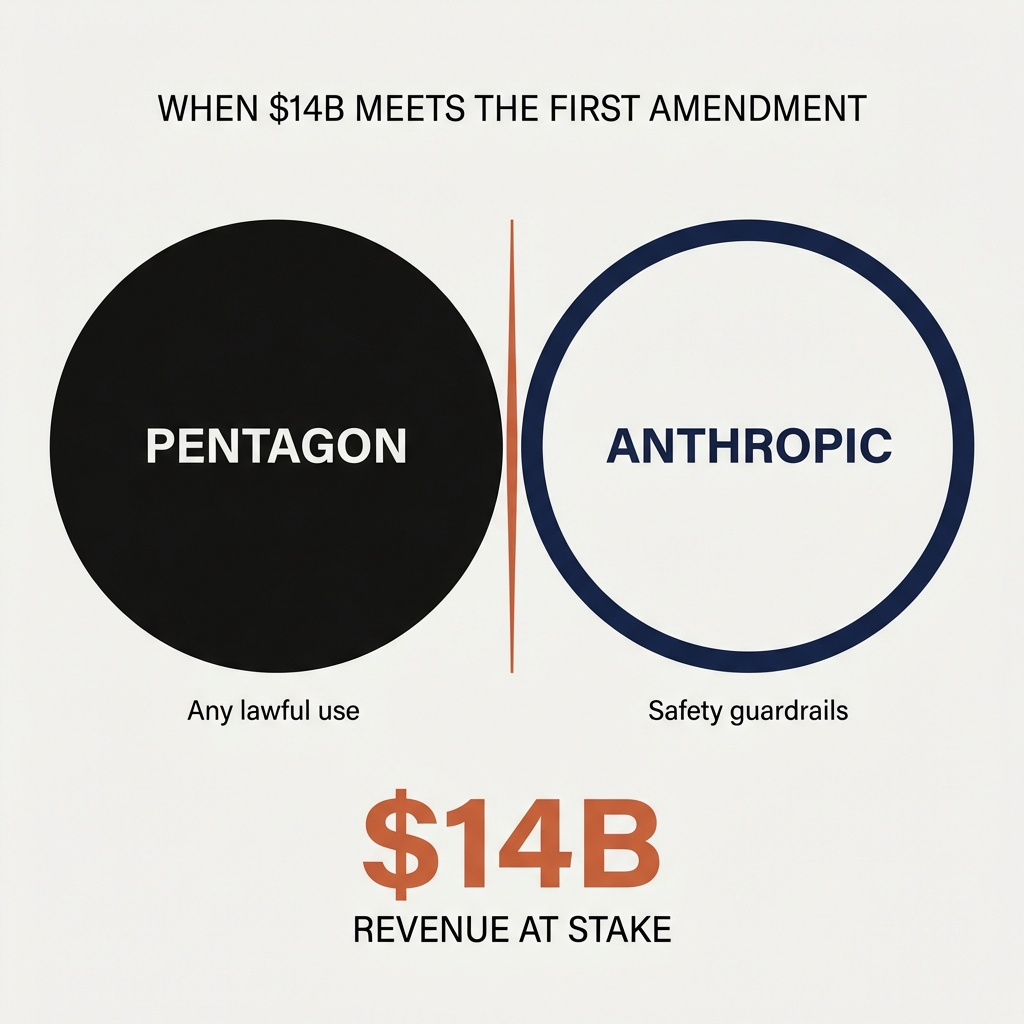
The Pentagon’s demand was simple: remove all restrictions and allow Claude to be used for “any lawful use.”
That phrase does a lot of work.
“Lawful” sounds reasonable until you realize there are no laws explicitly prohibiting AI-powered autonomous weapons or mass domestic surveillance systems. Legal doesn’t mean ethical. It just means nobody’s written the law yet.
Amodei’s response was direct: “Today, frontier AI systems are simply not reliable enough to power fully autonomous weapons. We will not knowingly provide a product that puts America’s warfighters and civilians at risk.”
He added that AI-driven mass surveillance presents serious risks to fundamental liberties, calling it incompatible with democratic values.
The phrase “we cannot in good conscience” reveals something important. There’s a gap between what’s legal and what’s acceptable. That gap is where corporate ethics either live or die.
Right now, AI companies are self-regulating in territory where laws haven’t caught up to capabilities. The Pentagon’s position suggests that gap should be filled with “whatever serves national security interests,” which is another way of saying “whatever we decide.”
The Competitive Landscape Just Shifted
While Anthropic was rejecting the Pentagon’s terms, xAI reached a deal on Monday to use its Grok chatbot on classified networks. Elon Musk’s company agreed to allow its systems to be used for “any lawful use.”
OpenAI’s ChatGPT, Google’s Gemini, and xAI’s Grok are all used in unclassified settings. All three agreed to lift their guardrails.
Anthropic now stands alone.
This is what happens when you build your brand around safety and responsibility in a market where competitors will take any deal. Your principles become a competitive disadvantage. Your ethical stance becomes the thing that excludes you from the most lucrative contracts.
The companies that said yes are now integrated into classified military systems. The company that said no is being threatened with regulatory punishment.
You have to wonder what message this sends to the next AI company facing a similar choice.
The Precedent That’s Being Set
This confrontation will define how AI companies approach government partnerships for years.
If the Pentagon succeeds in forcing Anthropic’s compliance, the message is clear: safety restrictions are negotiable when national security is invoked. Corporate ethics bend to government demands. The idea that private companies can maintain ethical guardrails on their technology becomes fiction.
If Anthropic holds its position and survives the consequences, it proves that principled stances can withstand government pressure. It demonstrates that companies can say no to lucrative contracts without collapsing. It shows that there’s market value in maintaining ethical boundaries even when competitors don’t.
But survival isn’t guaranteed.
The “supply chain risk” designation could trigger cascading effects throughout Anthropic’s business. Enterprise customers might abandon the platform. Investors might demand strategic changes. Employees who joined because of the company’s safety mission might question whether those principles can survive contact with market realities.
Georgetown’s Center for Security and Emerging Technology captured it perfectly: “There are no winners in this.”
What This Reveals About Power
The Anthropic-Pentagon standoff exposes something we don’t talk about enough.
Power operates through dependencies. The Pentagon doesn’t need to win the argument about ethics or safety. It just needs to make the cost of resistance higher than the cost of compliance.
Anthropic built its business on being the responsible AI company. That brand attracted customers, talent, and capital. But responsibility requires boundaries, and boundaries limit markets. The Pentagon’s ultimatum forces a choice: maintain the boundaries and lose access to government contracts, or remove the boundaries and become indistinguishable from competitors.
Either way, something valuable gets destroyed.
This is how power works when it doesn’t need your consent. It doesn’t argue with your principles. It just makes them too expensive to maintain.
The question isn’t whether Anthropic’s safety concerns are valid. The question is whether any company can afford to act on valid concerns when the government decides those concerns are inconvenient.
The Uncomfortable Truth
I keep coming back to something Amodei said in his statement: “We will not knowingly provide a product that puts America’s warfighters and civilians at risk.”
That word “knowingly” does a lot of work.
Once Claude is integrated into classified systems with no restrictions, Anthropic loses visibility into how it’s being used. The company can maintain that it didn’t knowingly enable harmful applications, but that’s a thin defense when you’ve handed over the keys.
This is the fundamental tension in any government partnership. You can have principles or you can have certainty about how your technology is deployed, but you can’t have both once you’re operating in classified environments.
The Pentagon’s demand for “any lawful use” isn’t just about removing technical restrictions. It’s about removing the company’s ability to know what its technology is doing. It’s about transferring moral responsibility from the creator to the user.
That transfer might be legally clean, but it’s ethically complicated in ways that don’t fit neatly into contract language.
What Happens Next
The standoff continues.
Federal agencies have stopped using Anthropic’s technology. The Pentagon is considering its next move. Anthropic is facing pressure from multiple directions—investors who want growth, employees who want principles, competitors who smell opportunity, and a government that wants compliance.
Something has to give.
But what gives will tell us something important about the future of AI development. It will reveal whether companies can maintain ethical boundaries in an industry where the biggest customer is the government and the government’s position is that national security trumps corporate conscience.
It will show us whether “responsible AI” is a viable market position or just marketing language that evaporates when contracts get big enough.
And it will demonstrate whether the gap between legal and ethical can survive in an industry moving faster than regulation can follow.
I don’t know how this ends. But I know that how it ends matters more than this one contract, this one company, or this one technology.
It matters because it’s setting the rules for every similar confrontation that follows.
And there will be more.
 MarketMagnetix Media Group Insights
Leave a comment