
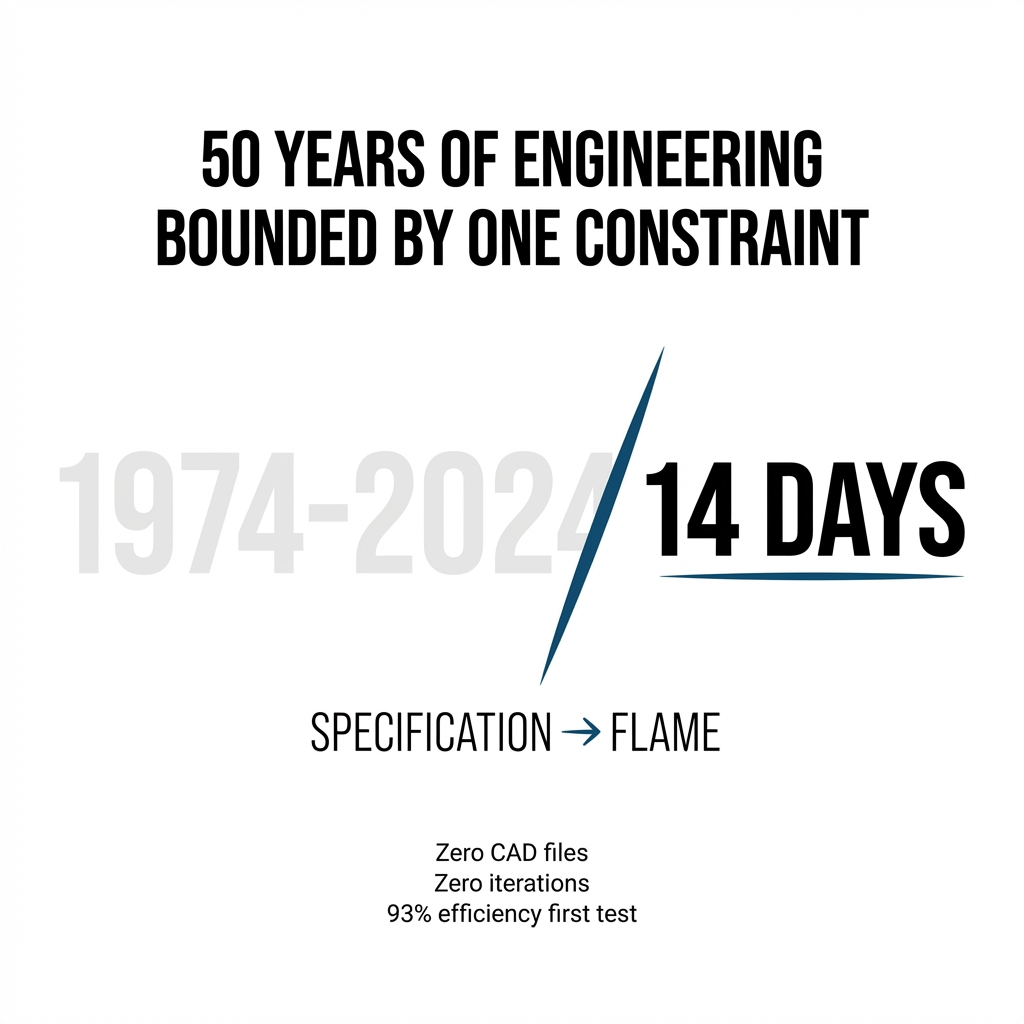
I’ve spent years tracking computational engineering breakthroughs, but nothing prepared me for what LEAP 71 accomplished between specification and flame.
An AI system called Noyron designed a fully functional rocket engine in less than two weeks. Not a prototype. Not a concept. A working 20 kN methalox engine that achieved full thrust on its first hot-fire test.
Zero human-drawn CAD files. Zero design iterations. Zero modifications between digital model and physical reality.
The engine worked because Noyron synthesized it directly from physics principles, bypassing the five-decade-old constraint that has shaped every manufactured object in modern civilization: human ability to conceptualize and draw complex geometry.
This isn’t incremental progress. It’s a fundamental rewiring of how physical objects come into existence.
The CAD Ceiling We Never Named
For 50 years, engineering innovation has been bounded by a limitation so ubiquitous we stopped noticing it.
If you can’t draw it in CAD, you can’t build it. If you can’t visualize it, you can’t specify it. If the geometry is too complex to model, the idea dies before it reaches manufacturing.
This constraint forced incremental thinking. Engineers optimized within known geometric paradigms because radical departures were too expensive to prototype and too risky to test.
The result was five decades of sophisticated variations on familiar themes.
Traditional rocket engine development reflects this reality with brutal clarity. NASA cost studies show that production fabrication and testing operations together represent over 80% of total engine development costs. Each iteration cycle compounds these expenses.
The first totally new large liquid propellant rocket engine developed since the Space Shuttle Main Engine required decades of development. Recent DoD major air vehicle procurement programs have needed more than 20 years from contract award to deliver fully operational aircraft.
The bottleneck wasn’t manufacturing capability. It was human cognitive bandwidth for managing geometric complexity.
LEAP 71’s approach eliminates this ceiling entirely.
Physics First, Geometry Second
Noyron doesn’t start with shapes. It starts with physical requirements.
The AI defines thrust level, fuel type, combustion efficiency targets, thermal constraints, and pressure parameters.
The AI encodes first-principles physics directly into its computational model. It understands how fluids behave under pressure, how heat transfers through materials, how combustion dynamics interact with chamber geometry.
Then it synthesizes a design that satisfies those physics constraints.
The resulting geometry often looks alien. Organic. Impossible to have conceived through traditional CAD workflows.
But it works.
LEAP 71 has been firing a Noyron-generated engine on average every four weeks over the past 18 months. Each engine is distinctly different, testing the boundaries of the model’s physics representation.
In one remarkable demonstration, they hot-fired two radically different 20 kN methalox rocket engines in under three weeks from specification to first flame. One used a conventional bell nozzle. The other employed a full-scale aerospike design.
Both achieved combustion efficiency above 93% on first test.
That’s not iteration. That’s synthesis.
When Complexity Becomes Cost-Neutral
Traditional manufacturing economics penalized geometric complexity. More intricate designs required more machining time, more tooling, more quality control, more opportunities for error.
This economic reality shaped design thinking. Engineers learned to favor simplicity not because it was technically superior, but because it was financially viable.
AI synthesis combined with additive manufacturing inverts this relationship.
Complexity becomes essentially free.
If the physics validates the design, the system can build it regardless of geometric intricacy. A component with 10 features costs the same to 3D print as one with 10,000 features.
LEAP 71 demonstrated this principle at scale by manufacturing a 600mm diameter rocket engine component in four days using Nikon SLM Solutions’ 12-laser system. This represents one of the largest and most complex 3D-printed spacecraft parts ever produced.
The component is part of the XRB-2E6 methane/liquid oxygen engine using full-flow staged combustion. Industry insiders call FFSC “the holy grail of rocket propulsion” because it converts propellant’s chemical energy into thrust more efficiently than any other cycle.
It’s also geometrically complex enough that traditional manufacturing approaches make it economically prohibitive for most applications.
When complexity stops costing extra, optimization constraints disappear. Engineers can pursue the physically optimal solution rather than the manufacturable compromise.
The Transformation of Engineering Work
I’ve watched this shift reshape professional identity across the industry.
Engineers are no longer builders. They’re architects of intent.
The workflow now separates into three distinct roles:
Human as Orchestrator involves defining the desired outcome, specifying constraints, and establishing success criteria. This requires deep domain expertise and strategic thinking about what problem actually needs solving.
AI as Engineer synthesizes geometry that satisfies those constraints, optimizes for physics performance, and generates manufacturing-ready specifications. This happens in minutes on standard computing hardware.
Manufacturing as Validator builds the physical object, tests against real-world conditions, and feeds performance data back into the model. This happens in days or weeks rather than months or years.
The 14-day timeline from specification to successful test fire represents this new reality. Traditional approaches would have required months of CAD work, multiple design reviews, prototype iterations, and incremental testing.
LEAP 71 compressed that entire cycle into two weeks with a single successful test.
The time savings matter less than what they enable, which is different approaches to risk, innovation, and problem-solving.
What Feasibility Means Now
For centuries, engineers dismissed ideas as “too complex to manufacture” or “geometrically impossible.”
These weren’t scientific limitations. They were cognitive and economic ones.
The new paradigm suggests that the only real constraint is physics itself. If something can work theoretically, it can likely be built.
This fundamentally changes which problems humanity attempts to solve.
I’m watching this play out in LEAP 71’s roadmap. The 20 kN engines they’ve been testing represent only 10% of the thrust class they aim to hot-fire in 2026. Manufacturing validation is already underway for designs in the 200 kN and even 2,000 kN range.
That’s not incremental scaling. That’s exponential ambition enabled by removing cognitive bottlenecks.
The limiting factor is no longer “can we build it?” The question becomes “can we imagine it?”
The Imagination Bottleneck
This shift reveals an uncomfortable truth about innovation.
We’ve been constrained by execution capability for so long that we’ve stopped training ourselves to think radically.
Engineering education teaches optimization within known constraints. Professional experience rewards incremental improvement. Career advancement comes from mastering established methodologies.
The entire system selects for people who work well within existing paradigms.
Now the paradigm is dissolving.
The new scarcity isn’t technical skill. It’s the ability to formulate novel problems worth solving.
I see this playing out in how organizations respond to AI-driven design tools. Teams with deep physics intuition and clear problem definitions achieve remarkable results. Teams that expect the AI to define the problem for them struggle.
The bottleneck shifted from “how do we build this?” to “what should we build?”
That’s a profoundly different question. It requires different skills, different organizational structures, different ways of evaluating talent and contribution.
Beyond Aerospace
Rocket engines make for compelling demonstrations because the physics is well-understood and the performance metrics are unambiguous.
But the implications extend far beyond aerospace.
Any domain where geometric complexity intersects with physical performance faces the same transformation. Heat exchangers. Turbine blades. Medical implants. Structural components. Fluid handling systems.
The pattern is consistent. Define the physics constraints, let the AI synthesize the geometry, manufacture with additive processes, and validate with rapid testing.
I’m particularly interested in applications where traditional design approaches have created persistent performance limitations. Places where engineers know the current solution is suboptimal but can’t conceive of manufacturable alternatives.
Those are the domains where AI-driven synthesis will have the most immediate impact.
The broader question is what happens when this capability becomes accessible beyond specialized engineering firms.
The Concentration Question
LEAP 71’s vertical integration strategy tells you something important about the current state of this technology.
They’re not licensing Noyron broadly. They’re using it internally to design and manufacture components.
This suggests the expertise required to define effective physics constraints and validate AI-generated designs remains highly specialized.
The democratization narrative around AI tools assumes that access to the technology creates equal opportunity. But computational engineering reveals a more nuanced reality.
The tools may become widely available, but the knowledge of how to use them effectively remains concentrated among organizations with deep physics expertise and advanced manufacturing capabilities.
This creates an interesting dynamic. The barrier to entry for sophisticated engineering drops dramatically for those who can formulate the right questions. But formulating the right questions requires exactly the kind of domain expertise that traditional engineering education provides.
We’re not eliminating the need for deep technical knowledge. We’re changing what that knowledge gets applied to.
What I’m Watching For
The next 24 months will reveal whether this approach scales beyond rocket engines and specialized aerospace applications.
I’m tracking three specific indicators.
Cross-domain adoption asks whether we see AI-driven physics synthesis emerge in thermal management, fluid dynamics, structural engineering, and other domains with well-understood physics, or does it remain confined to aerospace?
Timeline compression examines whether LEAP 71 went from specification to successful test in 14 days and if other organizations achieve similar acceleration, or was this an exceptional case?
First-time success rates consider whether the 93% combustion efficiency on first test suggests the physics modeling is remarkably accurate, and whether we see this pattern hold across different applications and design challenges.
These metrics will tell us whether we’re witnessing a genuine paradigm shift or an impressive but isolated achievement.
The Real Question
I started tracking LEAP 71 because rocket engines are hard. They operate at extreme temperatures and pressures. The physics is unforgiving. There’s no room for approximation.
If AI-driven synthesis works for rocket engines, it can work for almost anything.
The successful hot-fire test validated more than a single design. It validated an entire approach to engineering.
But validation doesn’t guarantee adoption.
The history of innovation is filled with technically superior approaches that failed to displace established methods because the organizational, economic, or cultural barriers were too high.
The question isn’t whether AI-driven physics synthesis works. The question is whether existing engineering organizations can adapt their workflows, incentive structures, and professional identities fast enough to capitalize on it.
I don’t know the answer yet.
But I know this: the organizations that figure it out first will have an asymmetric advantage in any domain where geometric complexity has been limiting performance.
And that’s most of them.


 MarketMagnetix Media Group Insights
Leave a comment