
I started pulling numbers on defense manufacturing capacity last month, and something didn’t add up.
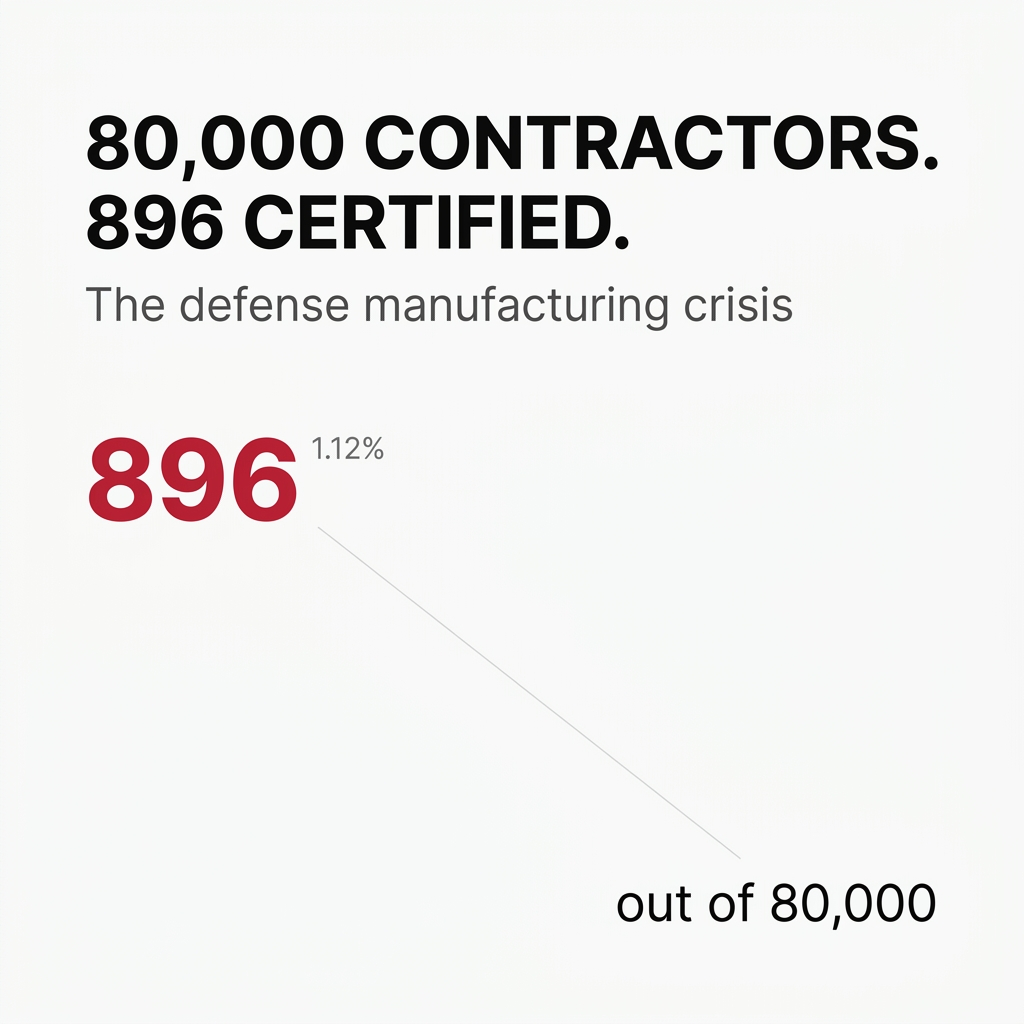
The Pentagon keeps talking about surge capacity, reshoring, and faster production. Meanwhile, only 896 organizations have achieved CMMC Level 2 certification out of roughly 80,000 that will need it.
That’s 1.12%.
The math gets worse when you look at the infrastructure. Approximately 80 authorized C3PAOs serve 80,000 contractors requiring Level 2 certification. Current assessor capacity sits under 800 professionals, while industry estimates put the actual need between 2,000 and 3,000 Certified CMMC Assessors.
The bottleneck isn’t theoretical. It’s already here.
The Certification Math Doesn’t Work
Many C3PAOs are booked throughout 2026 already. Wait times will exceed 18 months for new clients by Q3 2026.
For a mid-sized defense subcontractor, a C3PAO assessment typically takes 4-8 weeks of active assessment work. That doesn’t include pre-assessment preparation, documentation review, or remediation. Total time from gap analysis initiation to final certification: 12-18 months for most organizations starting from a moderate baseline.
Phase 2 begins November 10, 2026. That’s when self-attestation ends for the majority of Level 2 contractors. Third-party C3PAO assessments become mandatory for contracts involving CUI on prioritized acquisitions.
The timeline doesn’t accommodate the volume.
The Financial Barrier Hits Hardest Where Capacity Lives
The DoD estimates that small defense contractors will spend over $100,000 to achieve CMMC Level 2 certification through a C3PAO assessment.
70% of defense contractors budgeted less than that.
The cost structure creates unintentional market manipulation. Smaller contractors pay approximately $3,200 per employee for Level 2 certification, while larger organizations average closer to $850 per employee.
This isn’t about security standards. It’s about capital availability.
Tier-2 and Tier-3 defense manufacturers operate in a different economic universe than prime contractors. They’re privately held, thinly capitalized, and heavily dependent on a small number of contracts. Their margins are narrow. Access to external financing is limited.
Unlike primes, they can’t easily pre-finance expansion in anticipation of future demand or absorb prolonged payment uncertainty.
When those firms close, capacity doesn’t reappear elsewhere. Tooling is lost. Skilled labor disperses.
The Exit Wave Is Already Projected
Between 33,000 and 44,000 companies will exit the defense market between 2025 and 2027 as compliance costs exceed the economic value of maintaining defense business.
This represents a catastrophic shrinkage of the industrial base during a critical transition period.
A 2022 DOD report on the state of competition within the defense industrial base found that the number of small businesses in the DIB had shrunk by over 40% over the preceding decade.
The certification bottleneck accelerates this shrinkage precisely when surge capacity is needed most.
What We Don’t Know Is the Bigger Problem
There’s no public registry of CMMC-certified machine shops.
No visibility into which prime contractors use which subcontractors.
No verification system to confirm defense work remains in U.S. facilities.
No mechanism for policymakers to understand supply chain risks in real time.
The American public knows about 155mm shells, Javelins, and Stingers only because the war in Ukraine “pulled the sheets off the bed.” There is no routine mechanism for policymakers to understand these risks.
Many smaller manufacturers have not even connected their systems to the internet. They operate in complete informational isolation and cannot share real-time production data, inventory levels, or capacity availability with potential defense contractors or with government agencies during a crisis.
You cannot manage what you don’t measure.
Strategic defense manufacturing policy operates without feedback loops or verification mechanisms.
The Investment Decision With No Data
Machine shop owners face a decision point right now.
Invest hundreds of thousands of dollars in CMMC compliance, ITAR registration, AS9100 certification, and facility modifications. Or exit defense work entirely.
They make this decision without access to:
-
Market demand projections
-
Certification ROI metrics
-
Contract stability indicators
-
Competitive landscape visibility
-
Public registry of certified competitors
Defense firms operate in a procurement environment that offers no credible long-term demand signal. Single-year appropriations, stop-start program funding, and constant requirements churn make it irrational for companies to invest in excess capacity, second-source tooling, or workforce pipelines that might sit idle.
The central failure of the U.S. DIB is the misalignment of incentives.
The Skills Migration Nobody’s Tracking
64% of manufacturers reported it was “somewhat difficult” or “very difficult” to hire skilled labor workers. 82% reported that it was either “somewhat difficult” or “very difficult” to find STEM workers.
A transition to a digital- and services-based economy over the last three decades has resulted in a decline in manufacturing and reduced the demand for skilled labor. Students are not encouraged to enter skilled trades, which has resulted in a massive decline in the workforce needed to surge the defense industrial base.
The certification divide will accelerate skills migration from uncertified to certified shops.
Certified shops can offer premium wages for defense work. Machinists follow the money. Uncertified shops lose talent, accelerating their decline.
This creates regional economic winners and losers based on certification status rather than manufacturing capability, potentially hollowing out industrial capacity in non-certified regions.
The Pentagon’s Contradiction
The Pentagon has called for “expand manufacturing capacity in our national industrial base to prepare for surge production if deterrence fails.”
Meanwhile, the Pentagon treats industrial production capacity as an afterthought rather than a design constraint. What is insufficiently asked during early stages is whether the industrial base can actually manufacture the system in meaningful quantities.
This fundamental disconnect between policy aspirations and implementation reality undermines strategic goals.
Requirements get written. Systems get designed. Contracts get awarded.
Then someone asks: “Can we actually build this at scale?”
The answer is increasingly “no” or “not anymore.”
The Transition Vulnerability Window
The certification requirement creates a dangerous gap period.
The existing manufacturing base shrinks as shops close or opt out. The certified base hasn’t scaled yet to replace lost capacity.
This transition vulnerability occurs precisely when geopolitical tensions increase demand for rapid production capability.
The current U.S. defense industrial base lacks the capacity needed to meet the demands of 21st century great-power competition and possible war. More critically, the general trend remains negative with continued decline or at best stagnation in supplier count.
We’re reducing capacity while claiming to build readiness.
The Shop Owner With 30 Employees
Picture a machine shop owner in the Midwest. 30 employees. Mix of commercial and defense work. Skilled machinists who’ve been there for years.
Defense contracts represent 40% of revenue. Good margins when the work is there. Payment terms are tough—sometimes 60-90 days after delivery. But it’s steady when programs are active.
CMMC Level 2 certification will cost $150,000-$200,000. ITAR compliance adds another $50,000. Facility modifications for controlled areas: $75,000. IT infrastructure upgrades: $40,000.
Total investment: $315,000-$365,000.
The owner doesn’t know:
-
How many competitors are already certified
-
Whether prime contractors will shift work to larger certified shops
-
If defense contract volume will justify the investment
-
When certification requirements might change again
-
Whether programs currently in the pipeline will continue
The decision gets made anyway. Invest or exit.
This scenario is playing out in thousands of shops across the country right now.
What This Actually Means
The certification crisis isn’t really about certification.
It’s about information asymmetry preventing rational investment decisions.
It’s about regulatory compliance functioning as unintentional market consolidation.
It’s about strategic vulnerability during a critical transition period.
It’s about governance failure at the most basic level—the absence of registries, tracking systems, and verification mechanisms.
The machine shop certification crisis mirrors broader patterns in critical infrastructure: essential systems with distributed providers, high switching costs, information asymmetry, and regulatory complexity creating consolidation that reduces resilience while claiming to enhance security.
We’re watching the defense industrial base contract in real time.
The data exists to track this. The systems could be built to provide visibility. The registries could be created to enable informed decisions.
They don’t exist.
That’s the actual crisis.
896 certified shops out of 80,000 required isn’t a certification problem. It’s a symptom of systemic failures in how we think about, measure, and manage critical manufacturing capacity.
The shops are still there. The machinists still show up. The machines still run.
For now.
Sources & References
CMMC Certification Statistics:
-
Secureframe (February 2026): CMMC Phase 2: What to Expect and How to Prepare – Current certification numbers and C3PAO capacity data
-
Elevate Consult: CMMC 2.0 Certification for DoD Contractors – Projected contractor exits and compliance requirements
-
E-N Computers (March 2026): CMMC Compliance Deadlines in 2026 – Timeline requirements and preparation estimates
CMMC Compliance Costs:
-
PreVeil: CMMC Certification Costs – Per-employee cost analysis and DoD estimates
-
CISPoint (January 2026): CMMC Compliance Costs 2026: Complete Pricing Guide – Comprehensive cost breakdowns by organization size
Defense Industrial Base Decline:
-
U.S. Department of Defense (February 2022): State of Competition within the Defense Industrial Base – Official DoD report documenting 40% decline in small business participation
-
Defense News (April 2022): Kathleen Hicks warns of ‘substantial decline’ in defense-industrial base competition – Deputy Secretary of Defense on DIB shrinkage trends
-
Federal News Network (September 2024): A closer look at the shrinking defense industrial base – Bloomberg Government analysis showing 27.6% vendor decline
Manufacturing Workforce Challenges:
-
Air & Space Forces Magazine (February 2023): Defense Industrial Readiness ‘Going in the Wrong Direction’ – Manufacturing hiring difficulty statistics for skilled labor and STEM workers
-
IndustryWeek: Why America Has a Shortage of Skilled Workers – Analysis of skilled trades workforce decline in manufacturing
Additional Policy Context:
-
Coalition for Government Procurement: What Federal Contractors Need to Know About CMMC – Phase 2 implementation details and requirements
-
Defense Acquisition University (September 2022): Defense Industrial Base Health Concerns – DIB capacity and surge production analysis
MarketMagnetix Media Group
www.MarketMagnetix.agency

 MarketMagnetix Media Group Insights
Leave a comment