
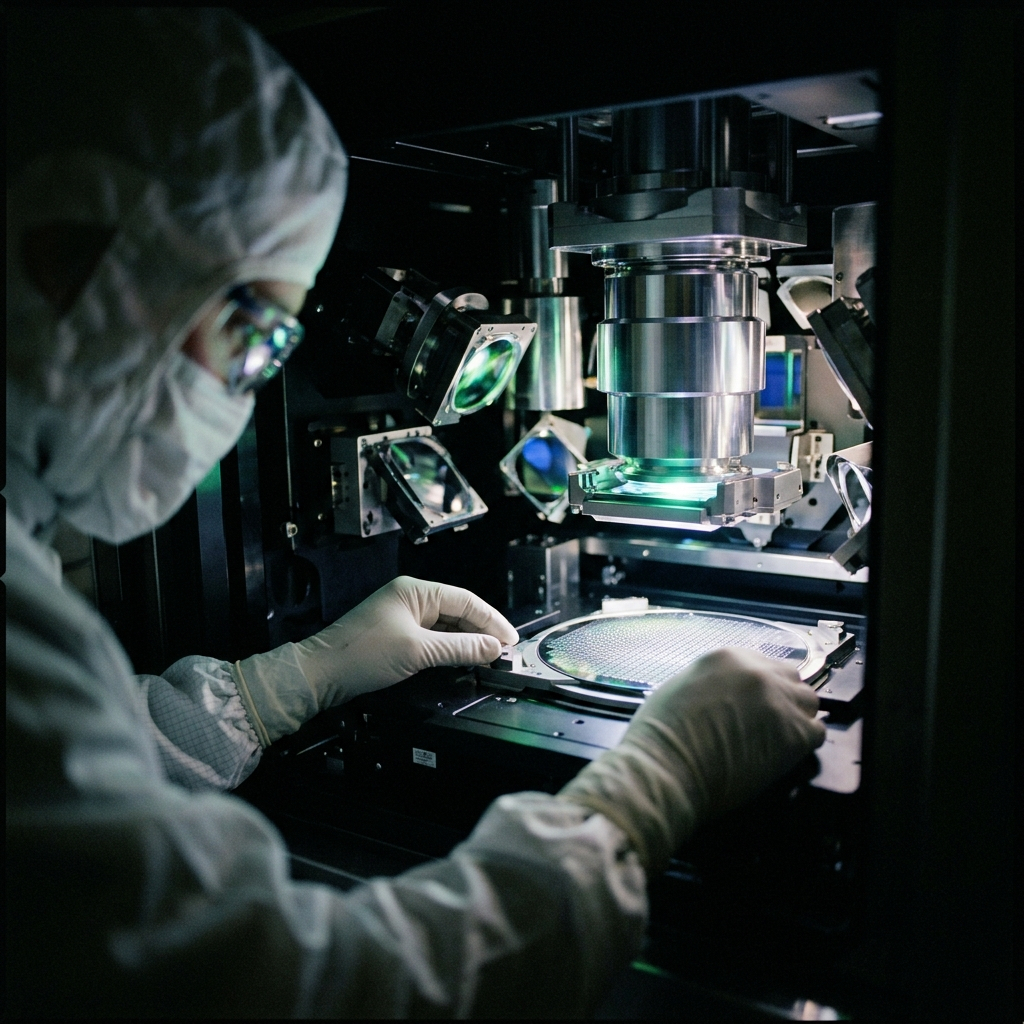
I’ve been watching the semiconductor industry long enough to recognize when a partnership announcement means more than the press release suggests.
Intel joining Elon Musk’s Terafab initiative isn’t just another corporate handshake. It’s a public admission of something the AI industry has been quietly struggling with for years.
Designing brilliant chips and actually manufacturing them are completely different businesses.
Tesla proved it can design competitive silicon. The company’s custom chips power its autonomous driving systems. But when Musk announced plans to produce 1 terawatt of annual compute capacity—roughly 50 times current global AI chip output—he didn’t double down on building manufacturing expertise from scratch.
He called Intel.
The Manufacturing Reality Nobody Talks About
Intel’s statement was carefully worded but revealing. The company emphasized that its “ability to design, fabricate, and package ultra-high-performance chips at scale” would help accelerate Terafab’s goals.
Translation: Intel isn’t just a supplier. Intel is running the fab.
This validates something fundamental about the semiconductor industry. You can’t compress decades of manufacturing knowledge into a few years of aggressive hiring and capital investment. The industry runs on accumulated process knowledge, yield learning, and supplier integration that resists acceleration through ambition or funding alone.
A modern 3nm-class logic fab requires 80-100 lithography scanners, hundreds of etching tools, hundreds of deposition tools, and over 100 metrology and inspection tools. Advanced fabs typically cost $10 billion and take several years to build—for a single facility.
The expertise can’t be bought. It has to be earned through painful iteration.
Why Intel Needed This Deal
Intel’s participation in Terafab represents more than helping a customer. It’s a continuation of CEO Lip-Bu Tan’s aggressive pursuit of external foundry business.
After years of falling behind NVIDIA and AMD in the AI chip race, Intel needed volume commitments from major customers to justify continued investment in advanced process nodes.
The company’s 18A node entered high-volume manufacturing in late 2025, completing the “5 Nodes in 4 Years” roadmap. It’s Intel’s first node with RibbonFET transistors and PowerVia backside power delivery—a technical leap that TSMC won’t match until late 2026.
Intel has a temporary technical advantage. But advantages mean nothing without customers.
Securing volume commitments from Tesla, SpaceX, and xAI gives Intel the revenue visibility to fund its technological comeback. The market recognized this immediately—Intel stock jumped approximately 2-3% following the announcement and has surged around 38% year-to-date in 2026.
For Intel, this partnership isn’t just business development. It’s validation.
The AI Bottleneck Is Physical
Musk claimed that all current fabrication facilities on Earth produce only about 2% of what Tesla and SpaceX will need across all projects. He stated bluntly: “We either build the Terafab, or we don’t have the chips, and we need the chips, so we build the Terafab.”
This reveals something most people miss about the AI race.
The companies winning are not the ones who wrote the best code. They are the ones who understood early enough that intelligence at scale is a manufacturing problem.
Software narratives dominate tech media. Algorithmic breakthroughs get the headlines. But the underlying constraint has been physical all along.
You can’t train frontier AI models without massive compute clusters. You can’t deploy autonomous vehicles at scale without custom silicon. You can’t build humanoid robots without specialized chips.
The bottleneck isn’t ideas. It’s production capacity.
Running 1 terawatt of AI compute continuously for a year would consume roughly twice the United States’ annual electricity use. The scale Musk is targeting doesn’t just require new fabs—it requires rethinking energy infrastructure, supply chains, and manufacturing economics.
Strategic Control Versus Speed
Tesla’s entry into chip manufacturing signals a strategic recalibration driven by AI’s explosive growth.
For years, Tesla relied on external foundries. The company designed chips but outsourced production to specialists. This approach worked when compute requirements were predictable and foundry capacity was available.
That world no longer exists.
As AI compute becomes mission-critical, companies are prioritizing supply chain control over the convenience of outsourcing. This represents a shift from just-in-time efficiency to strategic autonomy.
The question isn’t whether you can buy chips faster than you can make them. The question is whether you can guarantee supply when your entire business depends on it.
Roughly 92% of the world’s most advanced chip manufacturing capacity sits in Taiwan. For companies deploying AI at planetary scale—autonomous vehicles, satellites, humanoid robots—this geographic concentration creates unacceptable risk.
Terafab is simultaneously a resilience project and a power project. It’s a bid to internalize a strategic resource inside one corporate constellation rather than depend on the broader market of specialized suppliers.
The Culture Clash Nobody Mentions
Semiconductor engineers remain skeptical about Terafab’s timeline and execution.
Their skepticism reveals a cultural divide between Silicon Valley’s “move fast and break things” ethos and the methodical discipline required in chip manufacturing.
Semiconductor fabs measure success in yield percentages and defect densities accumulated over years. The industry doesn’t reward rapid iteration. It punishes mistakes with hundreds of millions of dollars in scrapped wafers.
You can’t sprint through process development. You can’t skip yield learning. You can’t compress qualification cycles.
Manufacturing excellence requires patience that resists the startup mentality.
Whether Musk’s execution-focused culture can adapt to this reality remains the central question. The gap between announcement and production represents the chasm between vision and manufacturing reality.
Industry analysts highlight that while the partnership is real, execution timelines remain unclear. Equipment delivery, process development, yield ramp, and qualification can take years longer than planned.
For Tesla’s autonomous driving and robotics ambitions, timeline slippage in Terafab could create cascading strategic vulnerabilities.
What This Means for the Industry
Terafab represents a tension between two competing philosophies in modern technology—horizontal specialization versus vertical integration.
For decades, the semiconductor industry thrived on specialized division. Design houses focused on chip architecture while foundries perfected manufacturing. This separation allowed each side to optimize independently.
The Terafab model suggests that as compute becomes existentially important to certain companies, the pendulum may swing back toward vertical integration.
This isn’t unprecedented. The integrated device manufacturer model once dominated the industry. Companies like Intel, IBM, and Texas Instruments designed and manufactured their own chips.
The industry shifted toward specialization because it was more efficient. But efficiency assumes stable supply chains and predictable demand.
When supply becomes strategic, efficiency takes a back seat to control.
Intel’s involvement carries geopolitical weight beyond the business case. As a U.S.-based manufacturer partnering with American companies on domestic chip production, Terafab aligns with broader national security objectives around semiconductor independence.
This partnership reduces reliance on Asian foundries for critical AI and defense-related applications. Analysts estimate that by 2026, the “geographic premium” for chips made in the U.S. could become reality as potential tariffs and trade restrictions on Asian-made silicon raise costs.
The Fundamental Question
Terafab forces every AI-dependent company to confront a fundamental question: at what point does building internal capabilities become more strategic than buying from suppliers?
This calculation depends on scale, strategic importance, and timeline.
For most companies, outsourcing remains the right answer. Semiconductor manufacturing requires specialized expertise that doesn’t align with core business models.
But for companies deploying AI at planetary scale, the strategic value of supply chain control may outweigh the complexity and cost of building manufacturing capabilities.
Tesla’s evolution from designing chips to pursuing manufacturing capability suggests that the threshold has been crossed for a select group of companies with massive compute requirements.
The companies that control their chip supply will shape the AI future. The companies that depend on external foundries will compete for capacity.
TSMC maintains a dominant 75% market share of the leading-edge foundry business. The company’s advanced 2nm capacity is sold out through 2026, backed by massive AI demand.
This creates a strategic dilemma for companies without their own fabs. You can design brilliant chips but still face production bottlenecks if foundry capacity isn’t available.
What I’m Watching
The partnership demonstrates how large-scale customers can use volume commitments to influence foundry development priorities.
By guaranteeing substantial orders, Tesla gains influence over Intel’s process roadmap, equipment investments, and capacity allocation.
This dynamic could reshape foundry economics. Instead of diversified customer bases driving technology development, a few mega-customers with massive compute requirements could steer the industry.
I’m watching three things:
First, whether Intel can deliver on yield and timeline promises. The company has a history of process delays. Terafab’s success depends on Intel executing flawlessly on 18A and future nodes.
Second, whether Tesla’s culture can adapt to semiconductor manufacturing discipline. The industry punishes overconfidence. Manufacturing excellence requires humility and patience.
Third, whether other AI-dependent companies follow Tesla’s path. If Terafab succeeds, it could trigger a wave of vertical integration as companies seek strategic control over chip supply.
The semiconductor industry is entering a new phase. The rules that governed the last two decades—specialized division, outsourced manufacturing, global supply chains—are being rewritten by companies that view chip production as strategic infrastructure rather than a commodity service.
Intel joining Terafab isn’t just a partnership announcement.
It’s a signal that the AI race has hit a physical bottleneck that no software fix can solve.
 MarketMagnetix Media Group Insights
Leave a comment