
I’ve been tracking defense budgets for years, and I’ve never seen anything like this.
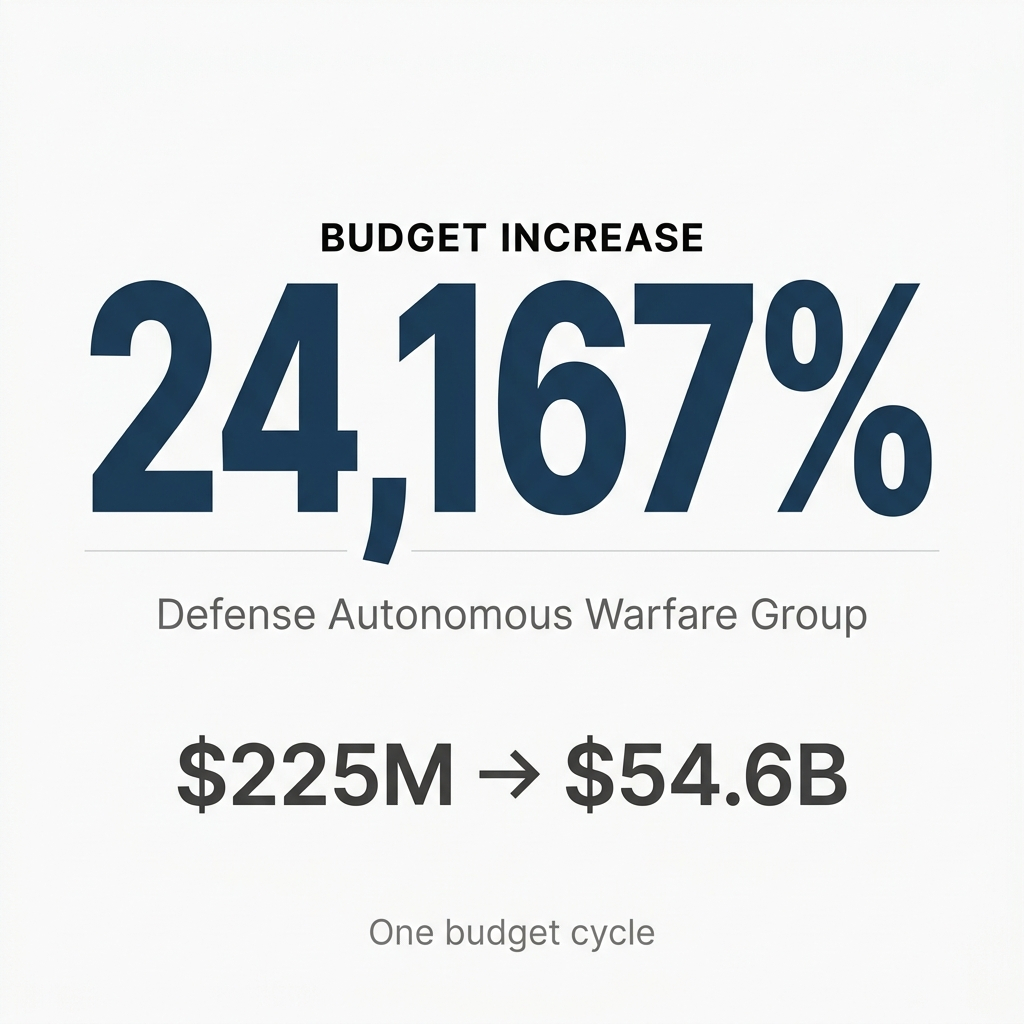
The Pentagon just requested a 24,167% budget increase for a single program. Not a typo. The Defense Autonomous Warfare Group (DAWG) went from $225 million to $54.6 billion in one budget cycle.
To put that in perspective: DAWG’s proposed budget nearly matches the entire Marine Corps budget of $57.2 billion.
This isn’t about buying more equipment. This is about fundamentally changing how America fights wars.
What DAWG Actually Does
DAWG focuses on one-way attack drones and unmanned attack boats that operate in coordinated swarms. Think thousands of autonomous systems working together, not individual platforms controlled by individual operators.
Deputy Secretary Stephen Feinberg and Emil Michael lead the initiative. They’re running live wargames in contested waterways, testing how drone and boat swarms perform in real combat scenarios.
The target geography tells you everything: the Taiwan Strait.
Admiral Samuel Paparo laid out the vision clearly: “I want to turn the Taiwan Strait into an unmanned hellscape using a number of classified capabilities so I can make their lives utterly miserable for a month, which buys me the time for the rest of everything.”
That’s not abstract strategy. That’s operational planning.
The Scale Problem Nobody Talks About
Ukraine sent more than a million drones to frontline units last year. One million.
The Pentagon’s Replicator initiative promised thousands of systems by August 2025. They delivered hundreds.
That execution gap explains the budget explosion. The Pentagon realized proof-of-concept doesn’t win wars. Production scale does.
During the first phase, 12 vendors will deliver 30,000 one-way attack drones at $5,000 per unit. Later phases aim to drive costs down to $2,300 per system.
Compare that to traditional deterrents:
-
HIMARS: millions per unit
-
Tomahawk missiles: millions per unit
-
SM-6 missiles: millions per unit
-
Switchblade 600 drone: over $100,000 per unit
The math changes warfare. You can afford to lose a $5,000 drone. You can’t afford to lose a multi-million dollar missile system.
The Real Challenge Isn’t Hardware
Building drones is the easy part. Commanding them is the hard part.
The Pentagon struggled to procure software able to command and attack with large numbers of different drones. This capability is fundamental to making swarms work.
That’s why they launched the $100 million “Orchestrator Prize Challenge.” The goal: let a single servicemember, without special training, give broad commands to whole groups of unmanned vehicles through text or voice.
Lt. Gen. Frank Donovan explained: “We want orchestrator technologies that allow humans to work the way they already command—through plain language that expresses desired effects, constraints, timing, and priorities—not by clicking through menus or programming behaviors.”
This is the bottleneck. You can manufacture 100,000 drones. But if you can’t coordinate them effectively, you just have 100,000 expensive paperweights.
China Isn’t Waiting
The urgency makes sense when you look at what China is building.
The PLAN is developing specialized UAV launch platforms. The Type 076 Sichuan redefines what an amphibious assault vessel can do by blending troop transport with power projection through unmanned systems.
These ships can serve as command nodes for drone swarms. Launch high volumes of smaller, expendable UAVs to saturate Taiwan’s air defense radars.
The Pentagon’s $54.6 billion request isn’t happening in a vacuum. It’s happening because peer competitors are developing parallel capabilities.
The Hellscape Doctrine
Here’s how the operational concept works:
Hundreds of cheap kamikaze drones approach from every direction. They’re mixed with decoys and antiship cruise missiles. Air defense ships have to fire interceptors at everything, depleting their limited magazines with each salvo.
This is the Hellscape strategy specifically designed for Taiwan defense. By incorporating drones into a layered, asymmetric dense-in-depth strategy, the concept provides Taiwan with enough cross-domain precision fires to defeat a Chinese amphibious assault at the water’s edge.
The economic logic is brutal: force your adversary to spend millions in interceptors to stop thousands in attack drones.
Attrition warfare, reimagined for the autonomous age.
From Program to Command Structure
DAWG plans to evolve into a full Autonomous Warfare Command—a joint organization coordinating swarm operations across all military branches.
This organizational shift matters as much as the technology. Traditional military hierarchies are optimized for commanding human operators. Swarm systems require distributed coordination where effectiveness emerges from collective behavior, not centralized control.
Ukraine’s Unmanned Systems Force and Russia’s Rubicon complex are serving as real-world blueprints. The Pentagon is watching these experiments closely.
Some observers have proposed establishing specialized drone branches within the services. The number of personnel needed to operate thousands of uncrewed systems, the training requirements, and the organizational changes required are all still being worked out.
This is institutional architecture catching up to technological capability.
What This Means Beyond Defense
The implications extend far beyond military applications.
Swarm intelligence development in defense will influence civilian technology in logistics, transportation, and infrastructure management. The same distributed decision-making systems that coordinate attack drones can optimize delivery fleets or manage smart city infrastructure.
The defense industry reaction is already visible. Founders are positioning their companies. Discussions focus on model performance versus lifecycle management. The emphasis is on rapid production.
This budget request will catalyze venture capital investment, talent migration, and startup formation in autonomous systems. Major government spending commitments create entire ecosystems of private sector development.
That’s the positive feedback loop between government demand and private innovation.
The Strategic Racing Dynamic
Committing $54.6 billion before full technological validation signals competitive pressure.
The Pentagon perceives that peer adversaries are developing similar capabilities. Delay creates strategic vulnerability. The cost of being second exceeds the cost of premature investment.
This pattern characterizes arms race dynamics throughout history. The difference now is the speed of iteration and the compression of traditional procurement timelines.
The operational environment is evolving faster than traditional acquisition processes can accommodate. This acceleration may represent a permanent shift toward more agile defense procurement.
The Execution Question
Congressional approval remains uncertain. But the request itself sends an unmistakable signal about strategic priorities.
DAWG amounts to a rebrand of the Replicator Initiative, which struggled with cost realism and production timelines. The question is whether the new name solves the old problems.
If DAWG can translate $54.6 billion into fielded, attritable systems at scale, it could reshape the force. If it becomes another procurement program that promises transformation but delivers incrementalism, it will join a long list of defense initiatives that looked revolutionary on paper but faded in execution.
The difference between those outcomes will define whether autonomous warfare becomes a core pillar of American military strategy or remains an expensive experiment.
What I’m Watching
I’m tracking three indicators:
Production timelines. Can DAWG actually deliver 30,000 systems in the first phase, or will “hundreds” become the new reality again?
Software integration. Will the Orchestrator Prize Challenge produce viable command-and-control systems, or will coordination remain the bottleneck?
Organizational transformation. Does the Pentagon actually create an Autonomous Warfare Command with real authority, or does DAWG remain a program office shuffling PowerPoint slides?
The budget number is shocking. The strategic implications are profound. But execution determines whether this becomes a genuine inflection point or just another ambitious plan that couldn’t bridge the gap from concept to reality.
The next 24 months will tell us which path we’re on.

 MarketMagnetix Media Group Insights
Leave a comment