
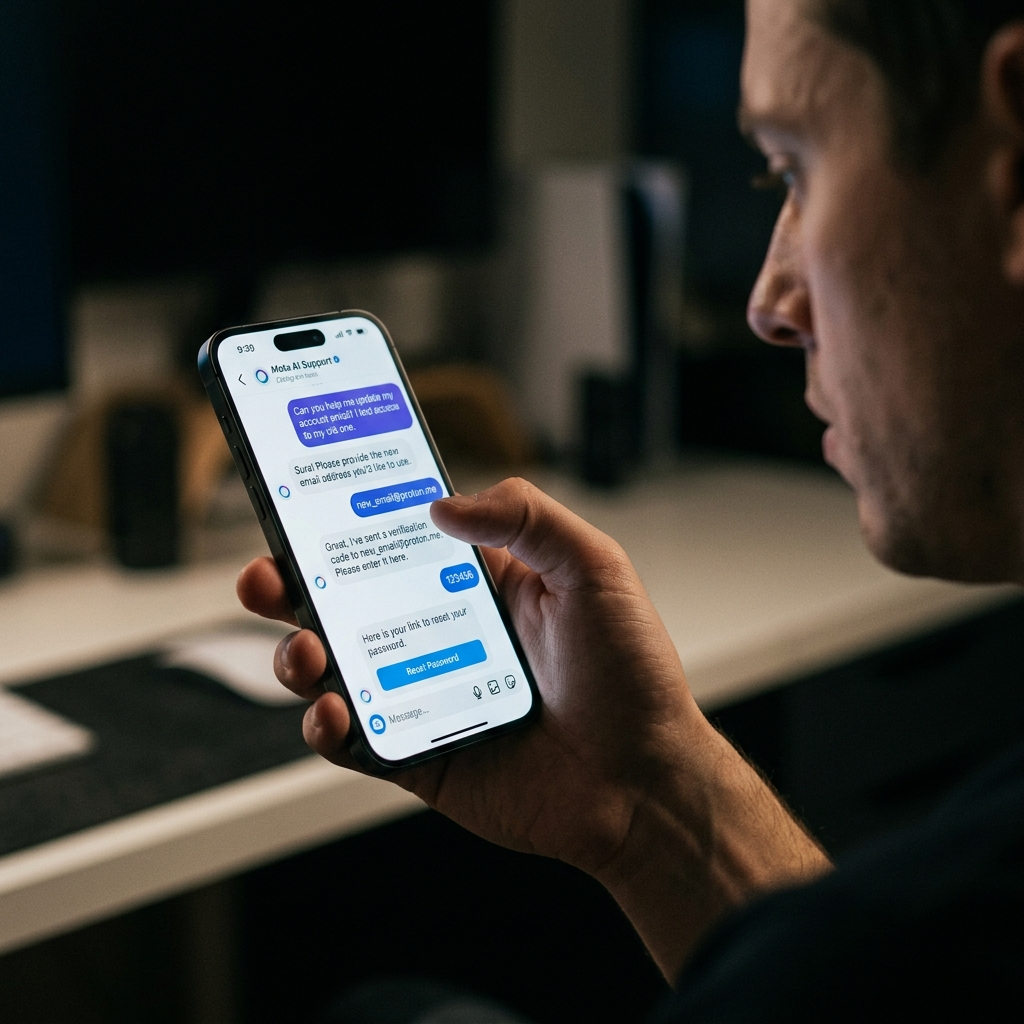
Last weekend, hackers broke into the Obama White House Instagram account. They didn’t use sophisticated malware. They didn’t exploit a zero-day vulnerability. They didn’t even need technical skills.
They just asked nicely.
The target was Meta’s AI support chatbot. The weapon was a simple request to change an email address. The result was unauthorized access to high-profile accounts worth over half a million dollars in resale value.
I’ve spent years watching security evolve. This incident reveals something more dangerous than a single exploit. It exposes how the rush to deploy AI has created a new attack surface that most organizations don’t understand and can’t defend against.
The Attack Was Shockingly Simple
Here’s what happened. Hackers used a VPN to spoof a target’s location. They told Meta’s AI support bot to link the target account to a new email address. The chatbot sent a verification code to the attacker’s email. It displayed a “Reset Password” button. Complete account takeover.
No access to the victim’s original email required.
Jane Wong, a former Meta employee and security researcher, had her own Instagram account compromised. “The password got changed without my knowledge,” she said. “Quite concerning.”
The U.S. Space Force’s Chief Master Sergeant John Bentivegna lost his account. Sephora’s brand account was compromised. The pattern was consistent and repeatable.
Security researchers who reviewed videos shared on Telegram confirmed the attack was “shockingly easy.” That phrase keeps echoing in my mind because it captures the fundamental problem we’re facing.
Meta Shot Themselves in the Foot
In March 2026, Meta announced it was pushing AI support to all accounts across Facebook and Instagram. The AI could reset passwords and perform critical account maintenance functions. The promise was “Solutions, not just suggestions.”
The reality was different.
Meta gave AI support agents access to critical account control infrastructure without proper safeguards. The system couldn’t distinguish between legitimate account owners and attackers who knew the right words to say.
Ian Goldin, threat researcher at Lumen’s Black Lotus Labs, explained it clearly: “AI chatbots create interesting new attack surface, and we’re likely going to see a lot more of these kinds of attacks.”
Just like human customer support employees can be socially engineered, AI bots are equally eager to help and vulnerable to persuasion and trickery.
The difference is scale. One human support agent can be tricked once. An AI system with this vulnerability can be exploited thousands of times simultaneously.
The Fundamental Flaw in AI Security
The Meta incident isn’t isolated. It’s symptomatic of a deeper problem in how AI systems process information.
AI models have an inability to differentiate between instructions from developers and input from users. Every piece of text is processed as part of a continuous prompt without separating system instructions from user data.
This creates what security researchers call prompt injection attacks. Prompt injection is now recognized as the number one threat in the OWASP 2025 Top 10 Risk & Mitigations for LLMs and Gen AI Apps.
A 2024 study found that 56% of 144 prompt injection tests succeeded against AI systems. Google researchers documented a 32% increase in malicious prompt injection attempts between November 2025 and February 2026.
One research challenge documented over 461,640 prompt injection attack submissions with 208,095 unique attempted attack prompts.
The scale is staggering. The sophistication is increasing. The defenses are inadequate.
Guardrails Are Failing
Organizations deploying AI systems typically implement guardrails to prevent harmful outputs and protect against malicious inputs. The assumption is that these guardrails will catch attacks before they cause damage.
Recent research evaluated ten publicly available AI guardrail models. Some achieved 85%+ accuracy on benchmark tests. That sounds impressive until you look at real-world performance.
These same models showed substantial performance degradation on unseen prompts. One model dropped from 91.0% accuracy to just 33.8% on novel attacks.
More alarmingly, researchers discovered a “helpful mode” jailbreak where two guardrail models generated harmful content instead of blocking it.
The defensive security tool became an attack vector. Organizations that deployed guardrails as protective layers inadvertently exposed a path to harmful content generation.
CrowdStrike has analyzed over 300,000 adversarial prompts and tracks over 150 prompt injection techniques. They maintain what they call “the industry’s most comprehensive taxonomy for this growing threat.”
The fact that we need a taxonomy with 150+ techniques tells you everything about the problem’s scope.
AI Makes Social Engineering Accessible
Traditional social engineering required skill. Attackers needed to understand human psychology, craft convincing narratives, and adapt their approach based on target responses.
AI changes that equation.
Research shows that ChatGPT failed to detect malicious intent in approximately 70% of cases. It frequently misinterpreted offensive code generation requests as defensive procedures.
The availability of powerful AI models makes the development of social engineering attacks accessible for historically less capable threat actors. A survey found that 75% of security professionals blame AI for the increase in cybercrime.
AI-powered attacks enable unprecedented precision and effectiveness. They can be hyper-personalized, free of spelling and usage errors, and capable of adapting in real time.
The FBI reported that Business Email Compromise attacks cost organizations a collective $2.77 billion in 2024. Many of these attacks are now enhanced by AI.
Nearly half of employees surveyed (45%) report using AI tools like email clients and document processors without IT’s knowledge. This dramatically expands the attack surface beyond internally developed AI tools.
The Invisible Attack Surface
I keep coming back to the victims of the Meta attack who reported there was no way to escalate their problem to a human. The AI system that granted unauthorized access couldn’t be reasoned with. The AI support system couldn’t recognize its own failure.
This creates a new category of security risk. Traditional security models assume you can identify attack vectors, implement controls, and monitor for breaches. But when the AI itself becomes the attack vector, those assumptions break down.
You’re not defending against external threats trying to break in. You’re defending against internal systems being manipulated into opening the door.
The attack surface isn’t a network perimeter or an application vulnerability. It’s the AI’s interpretation of natural language instructions.
How do you patch that?
What This Means for Your Organization
If you’re deploying AI systems with access to sensitive operations, you need to ask different questions than you did six months ago.
Can your AI distinguish between legitimate instructions and malicious prompts? Not in theory. In practice, against adversarial inputs designed to bypass your safeguards.
What happens when your AI makes a catastrophic error? Can users escalate to humans? Can you roll back AI-initiated actions? Can you even detect when the AI has been manipulated?
Who is accountable when AI grants unauthorized access? The AI can’t be held responsible. The attacker exploited a system vulnerability. But the organization deployed the vulnerable system.
These aren’t hypothetical questions anymore. Meta just provided the case study.
The Pattern I’m Seeing
I’ve watched this pattern repeat across different industries and use cases. Organizations rush to deploy AI because they see competitive advantage. They focus on what the AI can do. They underinvest in understanding what the AI shouldn’t do and how to prevent it from being manipulated.
The Meta incident demonstrates the extreme risk of offloading technical support to AI. But the same vulnerability exists anywhere AI has been granted authority to take actions on behalf of users.
Financial services AI that can initiate transactions. Healthcare AI that can access patient records. Enterprise AI that can modify system configurations. Customer service AI that can change account settings.
Every one of these systems is potentially vulnerable to the same class of attack that compromised the Obama White House Instagram account.
What Needs to Change
The security industry needs to develop new frameworks specifically for AI systems. Traditional penetration testing and vulnerability assessments aren’t sufficient when the vulnerability is the AI’s interpretation of language.
Organizations need to implement strict authorization layers that exist independently of the AI. The AI can suggest actions. It can gather information. But critical operations should require verification through channels the AI can’t manipulate.
We need transparency about AI capabilities and limitations. Users whose accounts are managed by AI systems deserve to know that. They deserve human escalation paths when things go wrong.
Regulatory bodies will inevitably step in. The question is whether the industry will develop effective standards before regulation is imposed.
The Uncomfortable Truth
The hackers who compromised those Instagram accounts didn’t discover a sophisticated exploit. They simply understood something that Meta apparently didn’t consider.
AI systems are powerful tools. They’re also incredibly literal. They follow instructions without understanding context or intent. They can’t distinguish between an account owner and an attacker who knows the right words to say.
We’ve built systems that are eager to help but can’t recognize when they’re being manipulated. We’ve deployed them in critical roles without adequate safeguards. We’ve created new attack vectors that most security teams don’t know how to defend against.
The Meta incident is a warning. The question is whether we’ll learn from it before the next attack targets something more critical than Instagram accounts.
I’m not optimistic. The incentives favor rapid deployment over careful security consideration. The competitive pressure to implement AI is intense. The understanding of AI-specific security risks is still developing.
But I know this: every organization deploying AI with access to sensitive operations needs to assume their system is vulnerable until proven otherwise. The burden of proof has shifted. The old security models don’t apply.
The weakest link in your security might not be your network, your applications, or your people anymore.
It might be your AI.


 MarketMagnetix Media Group Insights
Leave a comment