
Anyone who spent twenty years watching companies rise and fall learns one thing fast: the tool rarely matters. What matters is what people do with it.
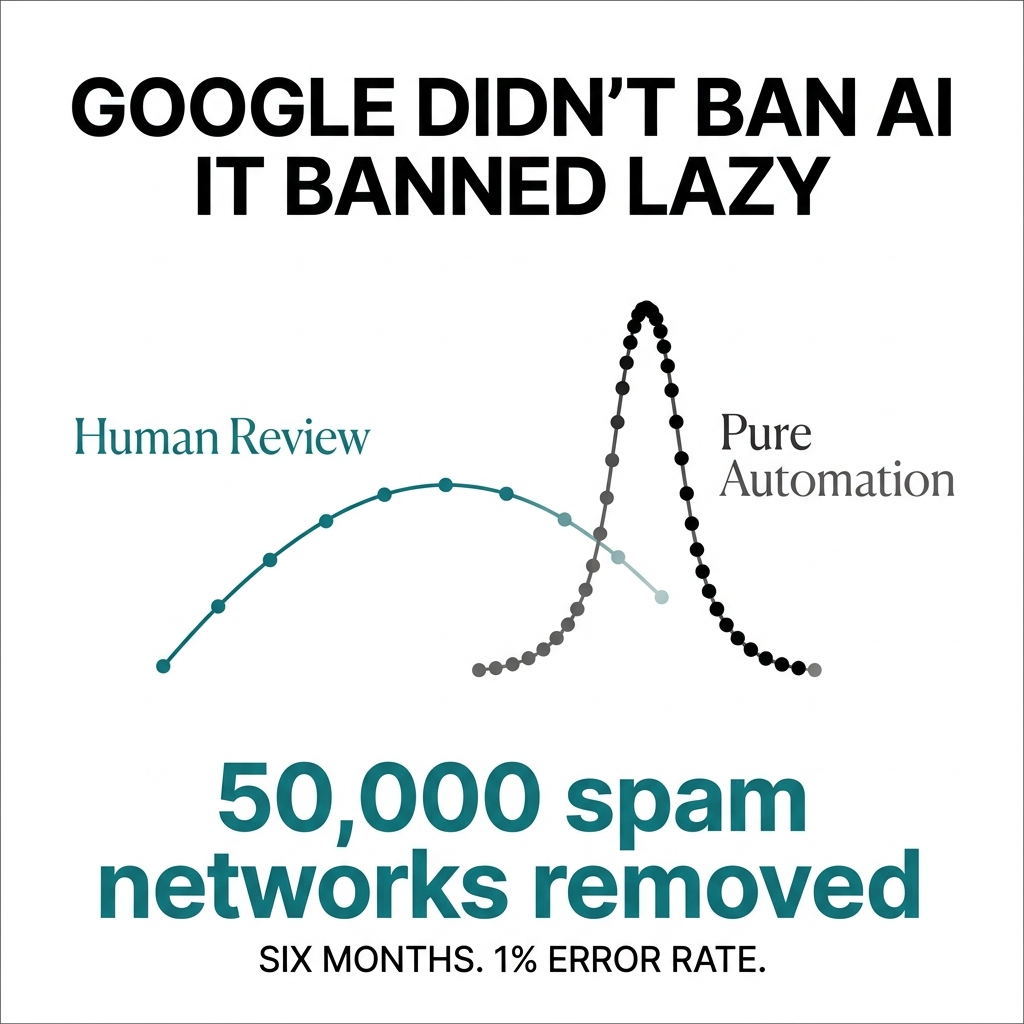
Google’s August Spam Update proved that lesson again. Reports across the SEO industry indicate the update targeted mass-generated AI content built primarily to rank in search results. Sites running fully automated publishing pipelines lost rankings across the board. Sites using AI carefully, with human review and genuine usefulness, largely kept theirs.
The distinction sounds subtle. It decides who survives.
What Actually Happened in August
The reports started rolling in mid-August. SEO practitioner @OkaTakuma1 observed that sites posting automatically with tools like Claude Code were “filtered and dropped across the board.” His theory: Google detects some kind of AI signature in the text itself, similar to the credits attached to generated images and videos.
He noticed something else, and this is the interesting part.
Sites that spent their early months publishing manually, building real engagement data, then switched to automation later, survived in many cases. Sites automated from day one had zero accumulated trust and got hit immediately.
💡 Think of it like a bank account. A site with years of deposits, meaning real user visits, real engagement, real satisfaction, can absorb a withdrawal. A brand new site running on pure automation starts at zero and gets no credit line.
One clarification matters here, and it’s commonly overlooked. Google works with user-generated signals rather than an abstract “trust score.” Users visit a site directly, engage with it, return to it. Those behaviors show Google that real people find the site valuable. That is measurable. “Trust” as a vague concept is unmeasurable.
The Method Is the Problem
SEO consultant @seiichi_satoweb put the sharpest frame on it. He told companies whose rankings dropped between August 18 and 21 to suspect their method of mass production before questioning individual article quality.
“Google defines the malicious use of mass-generated content as generating a large number of pages primarily for manipulating search rankings, not for supporting users. It’s not about whether it was created with generative AI, but what it was created for.”
Google’s own official guidance has said this since 2023. Using automation, including AI, to generate content with the primary purpose of manipulating rankings violates its spam policies. Useful, original content that satisfies E-E-A-T standards ranks fine regardless of how it was made.
The evidence backs this up. As of June 2025, roughly 16.51% of Google search results contain AI-generated content. Those pages rank in top positions. Google judges the output by helpfulness. The creation method stays neutral.
A Japanese publication that uses AI-generated content reported no penalties after the update. Every article passes a human visual check before publishing. The team also builds awareness through social channels and press releases, generating real impressions from real people. Their user signals look like a legitimate publication because they run one.
The Machine Behind the Curtain: S-CTS
Here’s where the investigation gets concrete. Google recently published a research paper describing S-CTS, the Scalable Cluster Termination System, a two-stage machine learning system designed to catch coordinated AI-generated spam.
The strategic shift inside that system deserves attention. S-CTS evaluates entire networks of accounts and sites for coordinated synthetic production. When the whole cluster shows the pattern, the whole cluster goes down.
The results at scale: Google’s system removed 50,000 coordinated spam networks in six months, with a 1% overturn rate on appeals. A 1% error rate on enforcement at that volume tells you the detection signals are strong.
What the System Watches
-
Templated structure. The research cites Sentence-BERT, a technique that catches AI text reworded on the surface while keeping the same underlying skeleton. Swapping synonyms fools nobody.
-
Publishing velocity. Fifty-plus articles in a week is a near-certain velocity flag. A dormant two-year-old domain suddenly publishing 200 articles in a month looks exactly like an old link network with a new AI pipeline bolted on.
-
Shared infrastructure. Same hosting, identical CMS configurations, the same Analytics ID, the same Search Console user across interlinked niche sites. All of it registers as cross-domain relatedness.
⚠️ If you run multiple sites through one AI pipeline on shared infrastructure, the system already sees the connections.
The Human Layer Agrees with the Machine
Google reinforced the algorithmic push with human judgment. In the January 2025 update to the Search Quality Rater Guidelines, Google directed its quality raters to identify pages whose main content came from automated or generative AI tools and rate them as lowest quality, according to Senior Search Analyst John Mueller.
Even the black hat community has noticed the flood. One Blackhat World Forums member described searching for a simple app tutorial and finding four back-to-back sites with identical AI formatting, the same subheadings and bullets, three sentences stretched into 500 words. His verdict: AI slop pages are the new doorway page.
When the people who make a living gaming search engines complain about spam quality, the market has clearly overheated.
What This Means for Anyone Publishing Content
Results after the update varied. Some publishers in private SEO communities reported ranking improvements for their AI-assisted content, particularly when they added unique elements beyond pure templates. Content heavily focused on keyword stuffing has been declining for years, and this update continues that trend.
Google’s Danny Sullivan offered the cleanest self-diagnostic. He advised anyone mass-generating content to ask whether they’re primarily doing it to game search traffic, or whether some user would actually expect that content if they came to the website directly.
That question separates the survivors from the casualties. Run it against your own publishing operation.
Three practical takeaways:
-
Put a human between the AI and the publish button. The surviving publications reviewed everything before it went live.
-
Build user signals early. Direct visits, engagement, and returning readers create the buffer that protected established sites in August.
-
Watch your velocity. Publishing at a pace no human team could review is itself a detection signal.
The tools keep getting better. The bar keeps rising with them. Publishers who make content for readers will keep ranking. Publishers who make content for algorithms just watched Google build a machine specifically designed to find them.



 MarketMagnetix Media Group Insights
Leave a comment